Andy Burnham has called recent high-profile rape trials a "watershed moment" for the UK and has opened the door to a wider ban on non-disclosure agreements.
The prime minister has brought forward changes to NDAs so that from January victims of crimes or workplace harassment will have complete freedom over who they can speak to, even if they have signed an NDA, and he promised the move was "just the start" of a crackdown.
Writing in the Guardian, Burnham said: "We'll only stop the violence when we end the silence. It's time for us all to speak up."
The debate about NDAs has been reopened in the wake of allegations against David Walliams of improper behaviour – which he denies – and the conviction of Russell Brand for rape and sexual assault. In both cases, it has been suggested that women with stories to tell felt silenced after signing an NDA.
The prime minister has also promised a consultation on a staggered age of consent after the accusations against both entertainers, including that Brand and Walliams had sexual relationships while in their 30s with girls of 16.
The consultation will also look at demands made by Joanne Young, who was drugged and raped by her husband and sexually abused by men he invited into their home. Philip Young, 50, advertised his then wife on dating and swinging websites, presenting it as a "kink" for both of them, and the men found guilty of raping her argued in court that they believed she had consented.
"At no point did anyone ask me for my consent," Joanne Young said. "I urge the government to look at this as a priority so that women are properly protected in the future." Ministers have promised a "serious conversation" that will also address "the false rape myth of 'third-party consent'".
Burnham noted comments made by Mr Justice Bennathan when sentencing Brand – in which the judge said that whatever women wore or drank, "they retain the right to say no and to demand justice" – and said rape myths had to be tackled.
"Let's be clear. No one 'asks for it' or deserves to be assaulted – ever," he said. "We know people react differently to traumatic events. And we know people are often reluctant to come forward because these accusations and stereotypes put the shame on women rather than the perpetrator, where it belongs."
On Tuesday, the Guardian revealed that the publisher HarperCollins used a leading legal firm and a non-disclosure agreement to "cover up" Walliams' behaviour towards women two years before the children's author was unexpectedly dropped, according to former staff.
Campaigners have argued that sweeping measures announced last year – which stopped short of a total ban, and covered only workers – have left the door open for companies and lawyers to cover up abuse. A total ban – which would make it an offence for a lawyer to make NDAs that cover up harm, including against fans and freelance workers – would better protect complainants and potential future victims, they say.
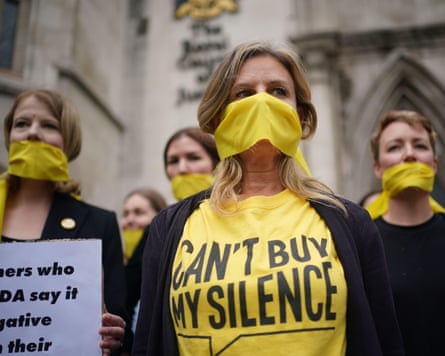
Zelda Perkins, a former PA to Harvey Weinstein who broke her NDA in 2017 and now spearheads the campaign group Can't Buy My Silence, said the move appeared to be "true action and a real commitment to major change from the prime minister".
She said it was a "significant moment", adding that decisions had been taken swiftly in recent weeks. "At many points during this eight-year battle to stop powerful people using our legal system to buy silence, it has felt like walking through treacle," she said.
"High-profile cases which have highlighted the continued use of NDAs to silence victims have really changed the conversation. They have laid bare the power and significant role of legal agreements in enabling these perpetrators."
On International Day for the Elimination of Violence Against Women, and the start of the UN's 16 Days of Activism against gender-based violence, Burnham promised the announcement was "just the start". He said ministers were working to close exceptions and loopholes, and promised a plan to ensure freelancers and fans were protected from the use of NDAs next year.
Perkins said she hoped the government would now consider a total ban on NDAs being used to cover up harm. "You perhaps can't always stop the depravity of an individual, but you can have laws and rules that do ensure people are able to talk about what happened to them."