Good morning and welcome to our UK politics blog.
Brexit – or reversing it, 10 years after the event – is the topic dominating the Sunday politics shows this morning after major deals were struck with the EU on Friday on trade, travel, emissions and visas for young people.
Andy Burnham says these are the first steps towards rebuilding "the bridges broken all of those years ago" with "our nearest neighbours and our largest market".
While he's voiced support for re-joining the bloc, he's also stressed that all options are on the table and there's a long road ahead in convincing the British public and securing the unanimous assent needed from the 27-nation bloc.
Critics have piled in this morning, warning how tricky of an endeavour this could be. Ex-PM Theresa May, whose government was brought down by Brexit in 2019, has told the BBC that the divorce "is done" and he should "move on".
That interview's coming up on Laura Kuenssberg's show later this morning. Meanwhile over on Sky, Brexiteer Michael Gove is hosting Reform and Tory naysayers as well as the European relations minister. I'll recap their comments.
I'll draw the blog to a close for now, here's a summary of the heated discussion about the new EU deals:
-
Conservatives and Reform have criticised the deals lifting red tape on food and agricultural products, aligning emissions trading schemes and the youth visas for 100,000 young people from both sides
-
They say the trade deal will bind British farmers to EU regulations and their "rulebook"
-
But Foreign Sec Ed Miliband says farmers selling products into the EU – the largest trading market – already face those rules; this just cuts out the "filling out of forms" and red tape involved
-
He says if the UK is part of the EU again too, it would also get to have a say in shaping the bloc's standards
-
Critics say the deal will also bring in young Europeans at a time when one million Brits aged 16-24 aren't in work or education; they argue they will be taking jobs from British people
-
Miliband says the deal "goes both ways" – young Brits will also be afforded the opportunity to work and live in Europe after a post- Brexit decade where that generation has received "a pretty raw deal". He says the government can address the Neets crisis while also giving young people this freedom and opportunity
-
Ex-PM Theresa May, who resigned after three years of struggling with the Brexit negotiation, says she's "aghast" that Burnham is touching the topic again. She says the British people voted and Burnham should move on
-
Burnham's government says they're not going to just put up with the Brexit deal that was achieved, which they say left Britain poorer and more isolated.
-
"If people think the status quo is really good on Brexit and that it's been great for Britain, well, they won't like this deal. I think most people think the status quo has been actually pretty rubbish. And we need to make it better, and that's what this deal does," said Miliband.
On Sky this morning, the Conservatives and Reform deputy leaders were also asked on if they'd ever enter into an election deal with Restore Britain.
"Given the line that they take on ethno-nationalism, I think that's very, very unlikely," said Tory deputy leader Alex Burghart.
Reform was accused by Michael Gove of leaving the door open for a deal with the even – further right Restore. Deputy leader Richard Tice said Reform wasn't "doing a deal with anybody".
Labour MP Emily Thornberry then interjected saying: "Labour will never do a deal with Restore. There we are. That's all you have to say. Reform will never do a deal with Restore. He can't say it."
Tice said: "I'm not doing a deal with Rupert Lowe."
European Relations Minister Hamish Falconer on Sky this morning criticised the post from earlier this week, where the US president shared a picture of him embracing Putin under the caption "My Friend".
Falconer said Putin was a "butcher" and "not a friend of the UK".
So would Vladimir be my friend? No. And he's not a friend of the UK either."
He said Andy Burnham had also made the UK's position clear to Trump.
The Prime Minister speaks to the president regularly, and is in absolutely no way pulling his punches about the strength of feeling that the UK has as a whole about Russia's invasion of Ukraine.
Tory deputy leader Burghart and Reform's deputy Tice also condemned Trump's post.
said:
"I'm sad and I'm depressed because you know the world that I grew up in was one in which the United States was a defender of freedom, and I worry that we might be moving into a world where that isn't the case.
said Trump's post was "wrong at every level".
It's a grave mistake. He is not our friend, Putin. He is, as others have said, a murderous dictator and no-one is in any doubt about that.
Critics of the youth mobility deal have mainly focused on the idea of an "influx" of European youth competing with Brits for jobs when there's this ongoing Neets crisis.
Roughly one million 16-24 year-olds in the UK aren't in education, employment or training (Neet).
Miliband on the BBC, points out that the UK already has such youth mobility deals with several countries, and the offer goes both ways.
There'll be young people from Britain going to work in Europe, and study, and live, and there'll be young people from Europe coming to our country as well.
I absolutely believe we can both address the issue of Neets, which I think Alan Milburn did excellently this week, and we can address the issue of young people having the freedom to go and work and live in Europe.
I think young people have got a really raw deal over the last decade, and it starts to put it right.
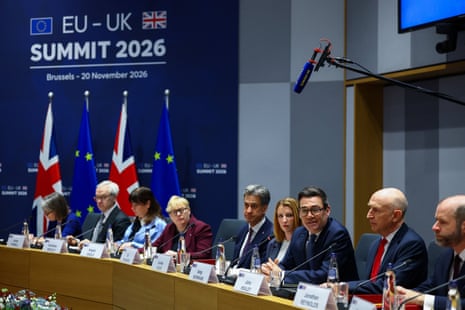
The Tories and Reform have made the argument this morning that the new food deal is "bad" for British farmers, because they will be subject to EU rules and standards.
They say more than 90% of British farmers currently don't export to the EU- so why should Britain have to cede that control over standards?
The government's response to this is that well, at the moment, farmers who sell into the EU already have to comply by the rules and also fill out loads of forms to prove they're matching the standards.
"This is why it's the worst of both worlds. We have to abide by the rules and fill in all the forms. What is the point of that?" says Ed Miliband on the BBC.
What we're saying is that actually, yes, we should integrate into the market where for the first time, we'll be able to shape decisions agreed to in the EU.
Reform UK's deputy leader has also slammed the new EU agreements as "a really bad deal".
He says "it's not a reset, it's a reverse" and claims that it won't add to GDP but actually reduce GDP. The government says it could lead to a 0.5% bump.
Tice doesn't elaborate on details here, or where that cost will come from but it appears his argument is: "The extra burdens of EU regulations that will be forced through dynamic alignment across all UK businesses is way more than that small net benefit."
"Yes, a few exporting food businesses may benefit. But what about all the bakers in Boston and Skegness and elsewhere in the country who don't export to the EU who will then have to suffer dynamic alignment amongst hundreds of thousands of other UK businesses that don't export."
A chief concern for the Europeans as to the idea of the UK rejoining the bloc is frankly, the lack of British political stability this past decade, and the fear that a change in government down the line would lead to another backflip.
Burghart this morning went as far as saying that a future Tory government would reverse the deals secured on Friday.
After laying out his opposition (on the grounds that he thinks UK farmers shouldn't be subject to EU rules), he told Michael Gove on Sky:
We will certainly repeal this deal. This is a very bad deal.
I wish that Andy Burnham had chose not to reopen the Brexit issue. I think there was no need to do so.
Foreign secretary on the BBC was also pressed on the business argument that cutting EU red tape on food and agricultural trade will make a grocery shop cheaper.
Kuennsberg raises the statement from the British Retail Consortium which says that the deals to cut red tape on food and agricultural products will "reduce pressure on trading costs" but are "unlikely to have any impact on prices in the near future" as "most of our food already comes from the United Kingdom."
Miliband refers to the statements from the big supermarkets.
"If you look at what Morrisons, the Co-op, Marks, and Spencer's, all of the food rate retailers have all welcomed this. And they've also said, it would apply downwards pressure on prices."
He says the government won't provide a number, or specify a certain item that will become cheaper but points out since Brexit, food exports have fallen 20% "because of the massive Brexit red tape that we have put on us".
And this deal will make a positive impact on both exports and imports, and crucially- this is the point that I noticed the retailers were making - it will reduce the costs that the retailers face, all of that Brexit red tape, millions of forms that they were having to fill in, frankly, pointlessly, as a result of the bad deals that we had.
If people think the status quo is really good on Brexit and that that's been great for Britain, well, they won't like this deal. I think most people think the status quo has been actually pretty rubbish. And we need to make it better and that is what this deal does."
Tory deputy head has been arguing against the deals on Sky and the BBC this morning.
He argues the removal of red tape on food and agricultural products is "really bad for business" as British farmers now will have to follow EU regulations when some don't even trade with the bloc.
He says this is a "a huge deadweight cost for them", and that that the EU has added even more regulations in recent years.
He also says that linking the emissions schemes means that "forces the UK to adopt the higher price of carbon that EU puts on businesses", and he argues that the 100,000 places youth mobility scheme will take jobs away from young Brits.
Gove puts to him that "business is pretty clear, that it's a good deal" and "almost every supermarket CEO says it will be good for consumers."
"So you're setting yourselves against businesses, and cheaper prices."
spent three years as prime minister (2016-2019) trying to negotiate the Brexit deal, before resigning.
She has told the BBC this morning she is "aghast" at the idea of Burnham resurrecting the issue, warning him of the enormous effort ahead:
What I saw was that the extent of those negotiations, the hours that have to be put in - it's across the whole of government. It's not just prime ministerial time, cabinet ministers' time, officials' time, to-ing and fro-ing on those negotiations. Because you have to negotiate hard in order to make sure that you're getting out what you want.
And that's one of the reasons why I look slightly aghast at what Andy Burnham is talking about, further negotiations of going into the EU.
And also we, as a country, we voted for Brexit. When I was prime minister I was very clear, we should deliver on that vote.
So I'm afraid my message to him really is, you know, people voted for Brexit. Brexit is done. Just accept Brexit and move on.
A summit in Brussels this week produced agreements which will:
-
Allow 100,000 young adults from each side to live and work in the other's countries for up to three years
-
Link emissions trading schemes, lowering carbon taxes on some exports
The PM says these first package of deals will create opportunities for young people and keep supermarket prices down. Marks & Spencer, Morrisons, Co-op, has been among the supermarket giants welcoming the move for customers.
At Brussels, there were also commitments to keep negotiating other areas. One key subject to be sorted out in the next six months is university fees for European students in the UK and vice versa.
An EU official briefing media said negotiations hadn't been easy but there had been good will to find solutions.
Good morning and welcome to our UK politics blog.
Brexit – or reversing it, 10 years after the event – is the topic dominating the Sunday politics shows this morning after major deals were struck with the EU on Friday on trade, travel, emissions and visas for young people.
Andy Burnham says these are the first steps towards rebuilding "the bridges broken all of those years ago" with "our nearest neighbours and our largest market".
While he's voiced support for re-joining the bloc, he's also stressed that all options are on the table and there's a long road ahead in convincing the British public and securing the unanimous assent needed from the 27-nation bloc.
Critics have piled in this morning, warning how tricky of an endeavour this could be. Ex-PM Theresa May, whose government was brought down by Brexit in 2019, has told the BBC that the divorce "is done" and he should "move on".
That interview's coming up on Laura Kuenssberg's show later this morning. Meanwhile over on Sky, Brexiteer Michael Gove is hosting Reform and Tory naysayers as well as the European relations minister. I'll recap their comments.