In Part 1 of this article series, I described the current financial and social crisis in France from 20 October 2026. Part 2 covers the developing situation from the next major phase of protests on 5 November 2026.
To recap briefly Part 1: France is going through a crisis on multiple fronts simultaneously. It has accumulated a huge national debt and is now paying around 5 per cent interest on its 10-year OATs (bonds). This sharp increase in yields is a reflection of the growing market concern about France’s incapacity to repay its debts. The IMF, the ECB, and the Banque de France are all concerned about France’s financial situation, and all three have issued warnings. To add to the financial worries, the French Parliament is negotiating next year’s budget, with President Macron hoping to calm the lenders by making €54 billion in savings. But he has a minority government, and at least the political left have sworn to vote down the budget. Meanwhile, the EU is demanding a far greater annual budgetary contribution from France from next year onward.
Other factors are aggravating the political situation. A presidential election is scheduled for May 2027, with two frontrunners. One is Marine Le Pen, who may be banned from standing at the last minute by a decision from the courts based on an earlier conviction of misusing EU party funds. The courts had earlier cleared her for standing for the presidency, but retained the power to ban her at the last minute. Le Pen has vowed that if she wins, she will cut France’s EU contribution to just €5 billion, which has put her at odds with the Brussels bureaucracy. Her party has divided loyalties to Jordan Bardella, a rival within her party. He is pro-EU and more likely to be the EU’s favoured candidate. The other frontrunner is the hard-line socialist Jean-Luc Mélenchon. He has vowed to cancel €600 billion of France’s sovereign debt, which both the ECB and the Banque de France have openly described as being a sovereign default. This would result in France either being unable to borrow money from the markets or needing to pay a far higher premium. Either way plunges France further into its financial crisis.
Meanwhile, the outgoing President, Emmanuel Macron, who cannot seek a third term, has been urged by his party to invoke Article 16 of the Constitution and declare martial law, which would allow him to cancel the presidential elections and remain in power.
Pouring a great quantity of petrol on all these flames is a fast-growing state of national unrest which has resulted in a series of increasingly widespread protests, many of which have descended into violence, as described in some detail in Part 1.
On 20 October, the nationwide protests mainly involved the CGT union, the students, and the . These groupings together managed to put around 800,000 people on the streets.
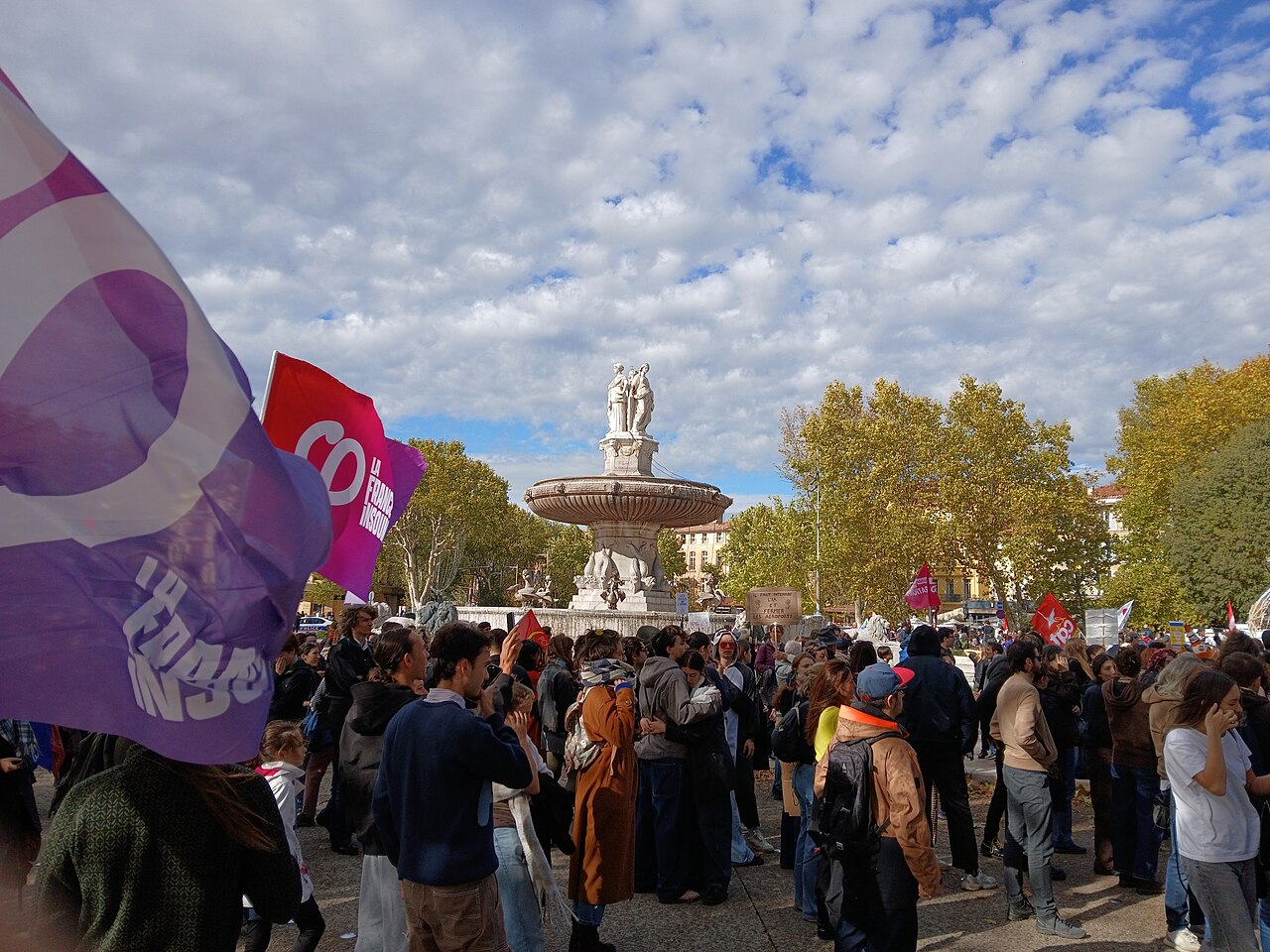
The next major protest took place on 5 November. Eight national trade unions were involved: the original militant CGT, the CFDT (more inclined towards negotiation), FO, UNSA, FSU, CFTC, CFE-CGC and Solidaires, in addition to smaller ones. The — whose demands from 2018-2020 were never met — pensioners, farmers, students, and others also participated. President Macron issued a decree banning all non-union protestors, and using his regional prefects has imposed many interdictions and conditions on the protests.
In addition to the protests in all major French towns, there were many national strikes, including trains, metros, schoolteachers, hospitals (A&E maintained), local governments, the post office and telecommunications. Some of the rail network was still planned to run, especially the TGVs, but there was major network disruption.
The union members involved in the 5 November protests could have been anywhere between 600,000 to 1.6 million, but the number of union supporters may have been as high as 5 million. It had been predicted that if the unions did manage to mobilise successfully, the numbers on the streets would be very large indeed compared to 17 October. The major unions involved managed to coordinate their demands into a coherent platform, which includes immediate pay rises, increased pensions, increased minimum wage, higher welfare spending, an additional €10 billion spent on education, increased taxation on the wealthy, and increased job protection.
All these demands for increased spending are directly at odds with the French Government’s plans to make €54 billion of spending cuts in the same areas where the unions want increased spending. At present, there seems to be very little prospect of agreement between the two highly polarised sides. If President Macron manages to impose his €54 billion in savings, the deficit for 2027 will still be 5 per cent, two percentage points above the allowed Maastricht ceiling. But, the EU, using the same budget data, comes out with a different figure of 5.4 per cent, casting doubt on the reliability of the French Government’s budget calculations. This means that even in the most favourable planned outcome, France’s borrowing will still increase massively. This would come at the price of pouring yet more fuel on the flames of national discontent. If the unions’ demands are met, the budgetary deficit is likely to be around 6 per cent, making the financial situation even worse than it is today. All this is playing out against a deteriorating economic situation, with both unemployment and inflation rising sharply and house prices falling.
What’s more, the Banque de France has been making massive losses over the last three years due to its use, in extremis, of quantitative easing, which would have been fine if borrowing rates remained low. But the bank bought its own debt when interest rates were low, and now rates are much higher and rising, causing increasing losses in the Banque de France. These losses amounted to €12.4 billion in 2023, €7.7 billion in 2024, and €8.1 billion in 2025. Re-evaluating the gold reserves has helped to offset the 2024 losses, but otherwise, these losses will need funding from the state.
Despite the government’s best efforts to play down the economic crisis in France, the subject has become part of the mainstream narrative over the past couple of months, especially with increasing rumours of the state operating a bail-in scheme by seizing money from citizens’ bank accounts. One of the deleterious, but entirely predictable, consequences is a capital flight out of France since the subject started to receive public attention. In 2022 and 2023, there were net capital inflows into France of €23 billion each, in 2024, there were inflows of €7 billion, in 2025, there was zero inflow, and in 2026 (to the end of September) there has been a €53 billion outflow. By the end of the year, this figure may well exceed €65 billion, leaving the banks with still less capital to fall back on in case of a default and further aggravating the financial crisis.
The first emerged between 2018 and 2020, as a spontaneous, amorphous, grassroots organisation without any clear hierarchy or leadership. However, a leader has now emerged in the form of Benjamin Ball. He has issued two broad sets of demands. The first is for a joint organisational front, linking the and the unions. During a 2 November television interview, he stated that none of the protesting parties acting independently has the power to influence the state and the oligarchs, but together they can achieve their objectives. These objectives are little less than a complete change to the way that France functions as a country.
Specifically, his demands are uncompromising and tantamount to toppling the Fifth Republic. On the economic front, he wants tangible improvements in people’s purchasing power, greater economic equality, further protection of social rights, and outright opposition to the current budget plans. On the democratic front, he wants greater respect for democracy, with the government listening to and obeying the will of the people, a transfer of power from the state to the people, and an end to the ‘presidential monarchy’ form of government. In addition, he states that if their demands are not met, then Macron and his entire government should leave office. Finally, he wants a new constitutional arrangement that respects citizens’ rights and wishes.
Benjamin Ball is a savvy and experienced political activist. At the age of 15, he organised his first school demonstrations and has over 20 years’ experience in organising protests. He has been involved in a variety of socialist organisations including UNEF, the Greens, Attac, , and . He is a Mélenchon supporter and is actively pursuing hard-left policies, turning the broad-based into a grassroots hard-left movement. This has alienated the right-of-centre from the 2018-2020 period, who advocated for financial changes in France without embracing a socialist agenda.
There is evidence that Ball is making some headway in his aim to coordinate unions and the . Thomas Vacheron, an officer of the CGT Union, in an interview with the paper , stated that the CGT is making efforts to coordinate its actions with other organisations, without wanting to take them over, and on 24 October, the CGT took part in the ’ organised protests.
In response to the 20 October protests, the Government deployed all of its police officers, amounting to a force of about 70,000, distributed across dozens of French cities. But the armed riot police (CRS), who are trained specifically for controlling and dispersing protests, are only about 13,250 strong and use various arms, including stun grenades, tear gas, and water cannon. There have been many complaints that tens of thousands of general service police are being brought into riot police roles without appropriate guidance and training. This resulted in frightened police reacting brutally to potentially dangerous situations that properly trained riot police could handle with more discipline.
There is a potential British link to the 5 November protest in France. In April 2026, the UK Government announced that it would provide £662 million to France’s CRS (crowd control force) over three years, including funding for a dedicated force of 50 officers and 75 ‘specialist’ officers. This force became active in June 2026. The stated reason for this force was ostensibly to provide stronger efforts toward preventing channel crossings. However, the CRS are riot police, not maritime coastal protection. They are used specifically to control riots in France, not to prevent illegal migrants from crossing into Britain. There is no public record of this UK-funded force being deployed against migrants.
In addition, the French presidential jet, a Dassault Falcon 900 (F-RAFP), has made some rather intriguing visits to the UK recently. On 3 November, it flew to the Isle of Man, where there is a flourishing offshore banking sector, holding at least £45.95 billion, as well as a gold bullion secure storage facility operated by IMGold. Isle of Man bank account holders generally do not feature in publicly searchable information. The Isle of Man is outside the control of both the EU and French banking authorities, so assets deposited there would normally be safe from a French banking collapse. On its return journey, it made a brief stop at the military base at Lydd in Kent, where military training and live fire training facilities are located. There has been no public explanation for this curious voyage. In January 2012, the MOD published an account of 3 Para performing hostile crowd training at Lydd, where a mock town has been constructed.
This, then, was the general situation on the eve of 5 November 2026. On the day itself, there was no clarity concerning the scale and scope of the protests, strikes, and violence, due to the widespread nature of the action and the French Government’s control over the mainstream media.
France’s Minister of the Interior published a protest attendance figure of 270,000 at lunchtime. The mainstream media used this number throughout the day as an accurate count of the protesters with the suggestion that the scale was less than half that of 17 October. This implied that the whole event had been something of a damp squib and that the protests were withering on the vine.
But it wasn’t. By 5pm, the CGT, the main organising union of 17 October, had produced detailed numbers. The total was 1,573,000 protestors across France, participating in 250 separate demonstrations in 207 towns and cities. Just before this, the Ministry of the Interior revised its official 270,000 protester figure to 575,000 across 193 demonstrations. Independent media reporting during the afternoon repeatedly described immense turnouts, showing seas of humanity as far as the eye could see in major cities. Common sense suggests that had happened, given that just one major union managed to put 800,000 protesters in the streets on 17 October. On 5 November, there were eight major unions involved together with the , farmers, pensioners, and a broad section of society, so a figure of roughly twice that of 17 October sounds reasonable.
Can we probe these figures further to establish any accuracy and help explain the difference between the difference of approximately 1 million between the union’s attendance figures and the state’s? We can certainly try. Firstly, the state only counted 193 demonstrations across France, whereas the unions counted 250. Were those 57 demonstrations overlooked or made up?
Let’s look at the timestamps on the three separate counts. At 1pm, the Ministry of the Interior established an official total of 270,000. At 5:30pm, the CGT issued a report of 1.573 million protesters. At 7:40pm, the Ministry of the Interior increased its lunchtime figure to 575,000. The 270,000 figure served the purpose of providing an estimate to the national and international media, but to anyone who followed France’s protests, it was clearly risible.
The Ministry of the Interior published its estimate of 575,000 via internal channels to the mainstream media and on its website. No member of the government or the state took responsibility for the number, so it cannot be attributed to any responsible individual.
By the time the state gave its figure to the press, it was already aware of the CGT’s estimate of 1.57 million, yet it made no attempt to rebut it. Nor did it produce a counting methodology or organisational participation, whether partisan or non-partisan, involved in producing the estimate. There was no breakdown of the figure by town. It simply produced the number, expecting everyone to believe it.
The CGT produced a brief press release at 5:30pm, which included the text:
More than 250 protests were organised throughout the country. At 5:30pm, the CGT counted 1.574 million protestors, of which: Paris 350,000, Marseille 150,000, Bordeaux 120,000, Lille, 100,000, Toulouse 80,000, Lyon 55,000, Nantes & Rennes 35,000, Rouen 30,000, Grenoble 28,600, Caen & Strasbourg 26,000, Brest 25,000, Tours 22,000, Orléans 20,000.
This gives a total of 1.1 million across 15 major cities, leaving a credible balance of 470,000 demonstrators distributed over 87 towns, an average of roughly 4,500 per town. It also produced an interactive map of demonstration times and locations which listed 263 demonstrations scheduled for 5 November. In addition, it published its counting methodology, which it had learned from the counting company Occurrence.
Then, on 6 November, the eight participating unions issued a joint statement in which they endorsed the CGT’s count, saying: “We were more than 1.5 million protestors throughout France.” In the same statement, they condemned the city prefectures, which had done their best to prevent the protests from taking place by various methods.
As of 6 November, the Government had still made no attempt to either justify its figure of 575,000 or disprove the combined estimate of the eight unions. It appears that the union’s figure of 1.57 million is closer to the truth than the state’s. Since the beginning of these protests, the same charade has been played out, with the state offering up derisory lower counts at lunchtime to the press, and then providing final numbers of roughly half those reported by the unions.
There will never be an absolute truth established with these figures, and readers are obviously free to decide for themselves where the truth lies. But I would respectfully suggest that, before reaching a personal conclusion, they look through social media videos of the protests (as opposed to mainstream media’s sanitised reports) to gain a feeling for the immensity of the protests and then scale that up to 207 different towns and cities. Mainstream coverage tended to show eye-level footage of protestors passing, whereas social media posts show videos from high vantage points down long boulevards packed with protestors.
If we look at individual cities for indications of whose figures are more likely to be telling the truth, there are very few independent estimates to give us a third perspective. One exception is Bordeaux, where the Government estimates that there were 21,000+ (whatever "+" means) in attendance. The CGT estimate was 120,000. However, another union that did its own count, FSU, published its estimate as between 90,000 and 120,000. The upper end coincides with the CGT, and lends it some credibility. If, the CGT estimate for Bordeaux is roughly correct, it adds further weight to the estimates of similarly sized cities and larger cities. All things considered, 1.5 million or thereabouts is probably not far from the mark. If that is the case, it makes the state’s estimate of 550,000 seem ridiculously low. However, when we look at all the other reported events during the day, the 550,000 undercount is consistent with what appears to be a coherent state strategy of downplaying and misrepresenting the protests.
All reports that I have seen, both from mainstream media and from social media, confirm a massive reduction in violence compared to 17 October. The Ministry of the Interior cites 2,628 arrests on 17 October compared to 448 arrests on 5 November. The 448 figure has since been revised to around 640 by the Ministry, but either figure demonstrates the massive decrease in arrests. Curiously, there have so far been reports of only two Black Bloc deployments on 5 November: one in Paris on Boulevard Voltaire and one in Lyon. This is in stark contrast to Black Blocs being recorded in most major cities on 17 October. It seems generally accepted by all parties that the vast majority of the protests, involving over 1 million people, took part in a peaceful, even happy atmosphere, and that Black Bloc deployment was severely restricted on 5 November. Compared to the 3,000 or so businesses looted, burnt, or ransacked on 17 October, only a few dozen appear to have been damaged on 5 November. Compared to the 300 banks broken into on 17 October, only one bank was targeted on 5 November. With far less Black Bloc involvement on 5 November, the violence, injuries, arrests, and destruction of property appear to be minuscule compared to 17 October.
The state appears, however, to have focused its attention on the messaging of the protests. As on 17 October, journalists were selectively targeted and beaten up by police.
The Society of Journalists reports two incidents from 5 November. The first involved Celine Martelet, a journalist working for . She was wearing a clearly identifiable high-visibility fluorescent press armband and was repeatedly shouting that she was a journalist. She and another journalist were backed up against a wall to avoid a police charge. Nevertheless, she was targeted and attacked by police and struck twice on the head with a baton, with the second blow causing an open head wound. She was saved from the attack and taken to hospital.
A second journalist, Cerise Sudry-Le Du, was with her, similarly dressed but wearing a helmet, and was also backed up against a wall. She, too, was attacked by police and received two baton blows to the head and two blows to the shoulders. Cerise was spared life-threatening injuries thanks to her helmet. An official complaint has been issued on their behalf.
Reporters without Borders (RSF) recorded many such targeted attacks on journalists wearing fluorescent press jackets on 17 October. For example, Mattias Enthoven was injured by a grenade, Miguel Martinez was struck with a baton, and Ricardo Pereira was hit by a grenade. The Black Blocs also attacked journalists. For example, Estelle Nilsson-Julien’s camera crew was assaulted, and their camera equipment was stolen. Emma Audrey was attacked, and her cameras were stolen, and so on. In addition to the attacks on 17 October, 20 others on reporters during protests in France were recorded between 17 October and 5 November. RSF has yet to compile a final list of injured, killed, or hospitalised reporters from 5 November, so we don’t yet know how many were attacked.
In addition, to make police violence more effective, prefects banned protection gear that could have helped save them from serious injury by the police. So, for 5 November, the Nancy Prefect banned the wearing of helmets, ski goggles, swimming goggles, diving goggles, construction goggles, gas masks, and joint protectors. A virtually identical ban was imposed in Lyon.
Celine Martelet, who was hospitalised with head wounds from the police attack on 5 November, had previously written several articles condemning police violence, including one documenting a teenager who lost an eye due to a police grenade in Mulhouse on 17 October. Her paper, , has published various articles on the dangers to the public caused by crowd control weapons, and the arrests and prosecutions of schoolchildren.
Another journalist suffered a sustained attack by police in Lyon on 5 November, receiving three blows to the head, which broke his helmet, and two blows to his leg, which broke his fibula. He was wearing a regulation fluorescent press armband.
The Ligue des droits de l’Homme (Human Rights League) published a complaint on 5 November condemning these and other human rights infringements. RSF published a substantial investigation covering the October protests entitled ‘Journalists Targeted during the Social Protests in France’. The European Federation of Journalists has demanded sanctions against the French police for attacks on journalists. Crucially, it appears that none of the compliant mainstream journalists appear to have been attacked by police, so the inference is that the police are selectively attacking journalists who are unlikely to toe the state’s line.
But 5 November wasn’t just a day of huge nationwide protests. It was also a day of national strikes. In the CGT press release cited above, a third of railway workers were out on strike. Other industries impacted included metalworkers, agricultural processing, and ports. Other unions brought out dockworkers, air traffic controllers and ground staff, post office workers, transport workers, glass and ceramics, hospitals and healthcare, teachers (52 per cent of secondary school teachers), construction, retail and commerce, chemicals, civil servants, and journalists.
In just three weeks, following the student protests of 17 October, the movement extended to over 207 towns and cities, with 1.5 million people on the streets covering most of the working population. This was an extraordinary ramp-up of power and intent by the protesters.
The scale and scope of the discontent in France are not lost on the government. According to a book just published in the UK and the US, entitled the New Shadow Army (La Nouvelle Armee des ombres), Macron’s Government has reportedly planned for a government in exile in case the people regain control of their country and topple the Government as the would like. The book explains how the state has transferred a slush fund of €100 million to a secret location to fund its activities. Could this be related to the Dassault 900 flight that I tracked to the Isle of Man just two days before the 5 November protests?
The French Government’s change in strategy has been discernible between 17 October and 5 November. Rather than instigating violence in the protests, the Government has turned to controlling the information space. This became particularly obvious on the evening of 5 November. I watched two mainstream French evening news programmes, TF1 and M6, both ostensibly private news organisations, but in reality both state mouthpieces. Both news channels broadcast largely identical protest-specific content, with the main story being the marches, which were portrayed as largely peaceful. Both channels then spent the rest of the segments on vox pop interviews. Nearly all the people interviewed gave their reason for protesting as the cost of living. A host of relevant issues were conspicuous by their absence.
There was no mention of the 10 demands listed by the students that triggered these national protests in September, which amount to a root-and-branch reform of the education system. There was also no mention of the more extreme demands. Among other issues, they demand a ban on war weapons used against protestors, equal rights to healthcare, education, water, and healthy food, an amnesty for all protestors held in prison/detention (4,914 protestors, out of which 1,829 have been charged), the establishment of a new political system including the creation of , an end to the presidential monarchy, the resignation of the president and the entire government if all their demands aren’t met, and government for the people by the people. Notably absent was any mention of all the protestors’ rejection of the current budget and further still the €50 billion planned budget cuts.
Although both channels showed Mélenchon, head of (LFI) and currently the second favourite in the presidential race, prominent at the head of the huge Paris march, there was no mention of his (and his party’s) intention to default on €600 billion of France’s national debt, nor his demands to stop sending arms to Ukraine. In addition, there wasn’t a single word broadcast about the nationwide strikes affecting so many of France’s industrial sectors. Instead of mentioning, for example, flight disruptions due to strikes by air traffic controllers and ground staff, they ran a lengthy piece on a commercial plane landing at a French military base because a bomb threat had been issued. They expanded this piece to cover a growing wave of bomb threats to commercial airliners, none of which has produced an actual bomb. Security analysts were interviewed linking these threats to Russia.
In short, according to the mainstream news, the protests were about the cost of living (which could conveniently be blamed on Presidents Trump and Putin), there was no mention of the national strikes or their impact on the country.
The French Government has now moved the zone of engagement to the information space, where it has significant control, just as the UK Government does. The media is not giving the French public any clear idea of what the protests and strikes are really about. What the public sees on the news is mass protests by people feeling the pinch and rioters destroying property.
Nevertheless, the Government made some concessions and announced several meetings with representatives following the pressure from 5 November. The first, and arguably the most important, was on 9 November, with five of the eight main unions involved in the 5 November protests. This was followed that afternoon by a meeting with students and high school representatives. Then, on 13 November, there was a meeting with public sector unions. In this way, the Government is splitting up the otherwise relatively united front of the protest movement by dealing with protester groups separately.
During the meeting with the unions on the morning of 9 November, the Government offered to bring forward the minimum wage increase initially scheduled from January 2027 to December 2026. The amount of the increase is just 1.6 per cent, a figure met with derision by the unions. The head of the CGT union, who demanded a net increase of 10 per cent, labelled it as “crumbs”. The head of the CFDT, usually a more conciliatory union, declared that the minimum acceptable increase was €100. The latest EU-harmonised figures for inflation in France are 3.8 per cent, and energy prices have risen by a whopping 24 per cent. Considering all the unions’ demands outlined above, bringing forward a planned minimum wage increase by one month could only have resulted in a complete rejection of the Government’s offer of conciliation. The talks failed utterly.
As a result of these seemingly sham negotiations, an intense programme of strikes and protests was planned over the coming days. On 10 November, universities and research centres went on strike. On 17 November, there was another day of nationwide strikes and street protests. The announced their own days of protest on 14 and 21 November. Throughout the month of October, there were eight days of strikes and protests. November has shaped up to be even more intense.
In response to these failed talks, various political parties have made their positions public. A spokesman for the LFI (Mélenchon’s party) expressed solidarity with the strikers and protesters, and added that if the Government was serious about calming the situation, it must listen to people’s complaints of economic hardship and act immediately with political measures.
Marine Le Pen sided with the Government, arguing that the dire state of French finances was too fragile to allow a 10 per cent rise in the minimum wage. The Horizons Party argued that wages were a matter of discussion between employers and employees.
The , which are calling for the Government to resign, have not been admitted to any talks with the Government.
The prospects for France looking forward appear chaotic, with a government caught between a rock and a hard place with no room for a manoeuvre and not budging an inch on the core demands of the protestors. Even if they succeed in beating down the unions, their budget deficit will still exceed their Maastricht limit and is hardly likely to reassure lenders — whose goodwill is needed to avoid a French default. The unions, feeling that they have the wind in their sails, are scaling up the frequency and intensity of protests and strikes. Meanwhile, yields on 10-year OATs are hovering just below 5 per cent, inflation and unemployment are rising sharply, and people are facing a winter with very high energy bills. The French Government will need the support of the ECB and probably the IMF if it is to deal with its massive debt and interest payment crisis, but for that help, it must achieve the €54 billion of savings. If it achieves those savings, a large section of the French population will get even angrier and more desperate.
In this fast-evolving situation, in which opposing sides are so entrenched and have so much at stake, it seems like the most likely outcome is far more chaos, the fallout of which may spread well beyond France’s borders.