Lord Ashcroft KCMG PC is an international businessman, philanthropist, author and pollster. For more information on his work, visit lordashcroft.com
Two new fronts look set to dominate political debate for the rest of this parliament. One – Britain’s relationship with the European Union – is of the prime minister’s own choosing. The other – how, and even whether, the country will live within its means – is one he would rather avoid, as we saw from last month’s Budget. But both will need to be reckoned with. What opportunities and hazards do they create for the main parties?
My most recent poll asked people whether they supported rejoining the EU, sorting out Britain’s finances by cutting spending and borrowing, both of these policies, or neither of them. Those who said they supported both were then asked which they would say was more important.

As we would expect, a clear majority of current Conservative and Reform-leaning voters favour cutting spending but not rejoining the EU. However, the second-place opinion differs: around one in five Tories support both policies, whereas around one in six Reform supporters oppose both. Among Conservative voters who support both, spending cuts are given priority by 67 per cent to 28 per cent. Very few Reform voters support both, but those who do break about three-to-one in favour of spending cuts being more important.
All three left bloc parties show strong support for rejoining the EU and are split on spending cuts. Current Labour voters narrowly support spending cuts by 50 per cent to 43 per cent; Lib Dems do so by a more convincing 20-point margin. The Greens are the only major party whose supporters say they oppose spending cuts, by a margin of 55 per cent to 34 per cent. Labour and Green voters who support both rejoining the EU and cutting spending and borrowing split evenly on which is more important, while Lib Dems prioritise EU membership by 56 per cent to 36 per cent. This creates a clear temptation for Labour to promote rejoining the EU as a distraction from polarising discussions about the public finances.
The chart below shows which of the two issues each party’s supporters consider to be the priority. The column on the right shows how opinion falls out among undecided voters.
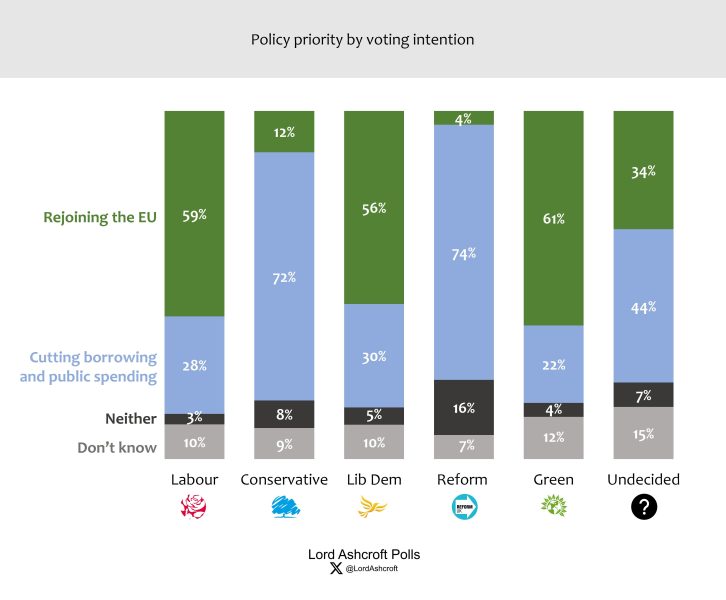
This shows the persuasion mountain facing Andy Burnham if he tries to make rejoining the EU the cornerstone of Labour’s next election campaign. Both Labour and Lib Dem supporters are more likely to consider EU membership a priority than the public finances – but about a third of his own supporters who express a view consider the public finances more important, and the proportion of Lib Dem voters thinking this is higher still. Moreover, undecided voters prioritise fixing public finances by a 10-point margin – this is despite undecided voters saying they would favour rejoining the EU in a hypothetical referendum by 57 per cent to 25 per cent.
When we ask about the top issues facing the country, Brexit consistently languishes outside the top ten. This suggests considerable hesitation even among people who are open to backing Labour and rejoining the EU. Yet if it became Labour policy, it would have to be front and centre of the campaign: rejoining is not a minor proposal which could be buried on page 94 of a manifesto.
Our political map shows how party support and prioritising EU membership or the public finances are distributed throughout the electorate. The size of a bubble is proportional to the size of the group in question, and the closer bubbles are, the more similar the voters in the respective groups. Here we see current voting intention in grey, and the policy priorities among current Labour, Conservative and Reform voters.

The three bubbles in red all nestle comfortably in Labour/LibDem territory just after “9 o’clock”. This suggests that there is a lot of political common ground among current Labour voters who hold different views on this topic; the corresponding blue and turquoise bubbles are more spread out, indicating that this is considerably less so for Conservative and Reform voters. Two groups of these voters warrant particular attention: Conservative voters who say that rejoining the EU should have greater priority than spending cuts, and Reform voters who oppose both rejoining the EU and making cuts to public spending. These groups each make up about 3 per cent of the electorate, but Reform is at much greater risk.
This month’s poll found the Conservatives on 26 per cent of the vote, with Reform on 18 per cent. Not only is 3 per cent of the electorate a larger slice of the Reform vote than it is of the Conservative vote, but Reform are polling at a level where the first past the post electoral system is working to their detriment: drops in support penalise parties in their position heavily. Moreover, Reform’s voters who oppose spending cuts are located in dangerous territory for them: adjacent to the bubble for “another party” – mostly Restore Britain. If Reform were to propose detailed spending cuts which alienate these voters, they have an alternative political home nearby. These people are also deep into the bottom half of the map where turnout is lower, suggesting that they could abstain from voting.
In contrast, current Conservative voters who prioritise rejoining the EU are found just before “12 o’clock” on the map: roughly equidistant from the Conservative bubble and the Lib Dem bubble. Current Tories who support both policies are firmly in the top right, just after “12:30”. That suggests that the Conservatives are at least as well-placed as any other party to compete for these voters. Furthermore, the Conservatives have made no secret of their resolution not to reopen the Brexit debate – yet these voters are currently intending to support the party despite this. Unlike anti-cuts Reform voters, this group’s position on the political map suggests they are less likely to respond to an unpalatable political choice by deciding not to vote.
In the context of these two major debates, then, the underlying dynamics of the current voting coalitions are most favourable to Labour and least favourable to Reform. But looking at a party’s current backers is only half the story: they will all be looking to widen their support ahead of the next election. Each month, we ask people to rate how likely they are to vote for each party on a 0-100 scale. People who rate a party at least 25 out of 100, but who are not currently planning to vote for it, are called potential voters for that party. Below we show how these priorities distribute on the map among potential Labour, Conservative and Reform voters; we also retain the voting intention bubbles for reference.

Labour’s potential voters are divided: a plurality want the government to prioritise rejoining the EU, but more than one in three think that sorting out the public finances is more important. Moreover, the three red bubbles on this chart are scattered across three different quadrants of the map – the opposite of what we saw above. If Labour’s current polling figure still includes a new leader bounce which will not survive contact with the first major necessary but unpopular decision, this could indicate a coalition built on a tectonic fault line.
Potential Conservative voters break strongly in favour of prioritising the national finances. Potential Tories who give priority to rejoining the EU are found around “10.30” on the political map; these voters are significantly closer to the Lib Dem bubble than the current Conservative bubble. While some of these people could vote Conservative at the next election, going out of her way to target these voters would be a stretch for Kemi Badenoch and could alienate current and potential Tories who disagree. On the other hand, the potential Conservative voters who support neither policy are found just after “3 o’clock”; these are close to, and hence share a political outlook with, the potential Conservative voters who prioritise spending cuts.
With Brexit part of their DNA, Reform face no dilemma over their position on EU membership. However, the public finances are a potentially tricky issue for Nigel Farage. Most Reform supporters say they favour spending cuts, but the party owes many of its gains in the 2025 and 2026 elections to its success in galvanising support from a group of people who usually do not vote. Many of these people could disappear if they come to see insurgent party they turned out for as another mainstream party offering a new version of austerity. When asked a forced-choice question about whether austerity is a way of protecting the rich at the expense of the poor, or simply a means of the country not spending more than it can afford, 31 per cent of Reform voters hold the former view, compared to just 19 per cent of Conservatives. Despite the superficial similarity in support for cutting spending, Reform voters are rather warier about how these cuts are spread.
The electoral dynamics favour Burnham’s in the short term, and the subtext of his conference speech was that the changes he believes the country needs are incompatible with Labour’s 2024 manifesto. Yet by raising rejoin as an electoral issue, Burnham has constricted his political breathing room: he has to spend time making the case that rejoining is a solution to this Britain’s problems in the 2020s, otherwise he will be fighting an election on an issue most people do not consider a top priority.
This suggests two morals for the Conservatives. Britain is £3 trillion in debt but in some areas – like defence – the country’s problem is that it spends too little. The magnitude of the problem means it can’t be solved simply by cutting “waste” or “bad spending” and leaving all the “good spending” intact. Badenoch has said what Britain needs is tough love, and both of those words are pertinent. She should challenge other leaders to engage honestly with the scale of the financial challenge the country is facing and set out, for scrutiny, what they intend to do about it. Toughness means confronting the issue squarely and being prepared to make unpopular choices in so doing. But voters are sensitive to the distinction between toughness and nastiness, especially when it comes to the Tories. The public finances must be sorted out – but their plan must show a vision beyond balancing the books.
Burnham wants to claim that getting on the path to rejoining the EU will help tackle immigration and spur growth, making choices on taxes and public spending less tough. Farage might say that dealing with immigration and boosting growth – and thereby making choices about public spending less tough – means doing Brexit properly. Badenoch, meanwhile, can argue that reheating the Brexit debate is a distraction on both counts: that tackling immigration requires leaving the ECHR and making sensible decisions about things like welfare entitlements and indefinite leave to remain, and that growth is about cutting tax, regulation and debt. In other words, banging on about Europe is a device used by politicians on both left and right to avoid telling voters how bad things are and how radical the change needs to be.