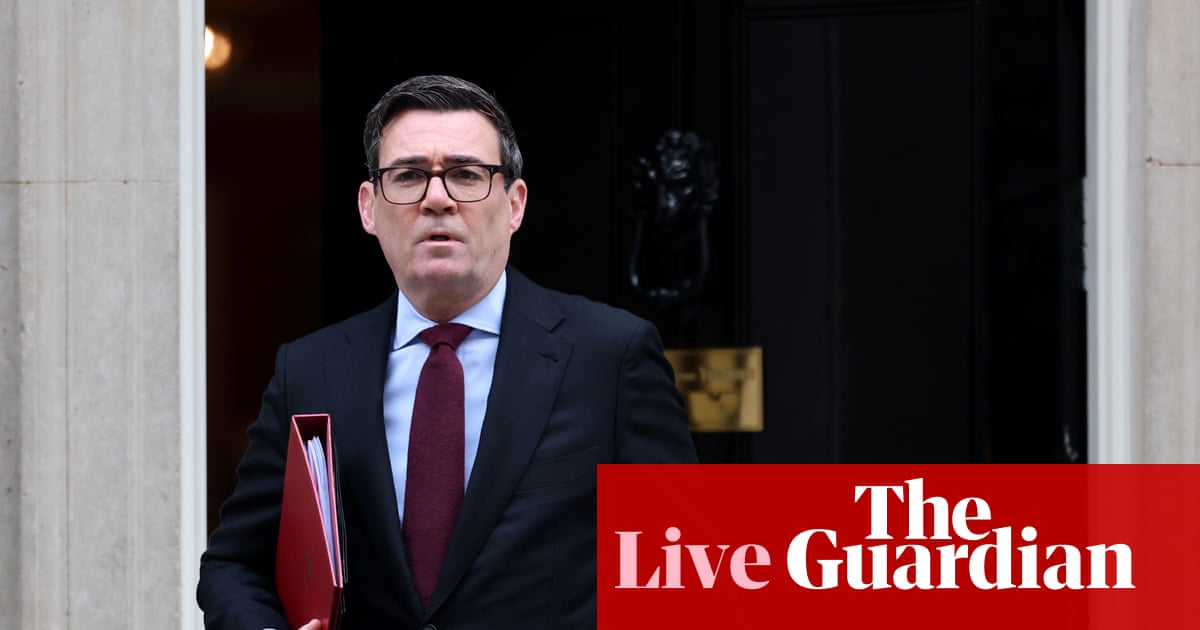
says the European Council has said that the tuition fees issue is linked to the three agreements announced on Friday, on food, emissions trading and youth mobility. If the EU does not accept the deal on tuition fees, will these deals go ahead?
says the government is tomorrow bringing forward the legislation for the three deals announced on Friday.
And the discussions on tuition fees will go on, he says.
He says the Tories are continuing to oppose a deal that will cut red tape. They are "the red tape Tories".
Kemi Badenoch and Ed Davey both asked about possible compensation for nuclear test veterans.
did not rule this out, but he said this was a matter for later in the process. He told Badenoch:
We should go wherever the truth take us and we should make whatever recompense is needed as a result.
And he told Davey:
I am not in any way walking away from the question of compensation, but I would just say today it's each step in its time.
, the Lib Dem leader, also welcomed the announcement. He asked Burnham if he thought nuclear test veterans should be getting an apology today.
said he had considered making an apology today, but decided it would be better coming after the report, or the interim report. He said:
I could have made such an apology today, but I would rather it to be a full, meaningful apology for the full extent of what is revealed so that it doesn't appear glib or not serious.
I remember I worked with David Cameron, who made the apology from this government despatch box, on the publication of the Hillsborough independent panel.
And it feels to me that that is the right time to do it.
But I am absolutely certain on 3 October next year or around that time, I will be standing here doing that.
responded to the statement. She praised the test veterans. She also asked if any money had been set aside for compensation, and she said that, given the importance of veterans, Burnham should also look again at the provisions in the Northern Ireland Troubles bill, which she said is "reopening the door to legal proceedings that remove protections against another group of elderly veterans who served our country".
thanked Badenoch for welcoming the announcement, but said the debate about the Northern Ireland Troubles bill was for another day.
said Bishop James has agreed to deliver an interim report "in time for the 75th anniversary of the first test on 3 October 2027".
Burnham paid tribute to all those who had campaigned on this. In particular, he singled out the Tory MP John Hayes, saying that he would be happy to refer to him as "my right honourable friend", terminology he would normally only use for a Labour MP, as a sign of the extent of his respect for him.
He also singled out two journalists for praise: "Susie Boniface, who has been utterly dedicated to this cause, and Victoria Derbyshire for the care of her coverage of it.".
He concluded:
I know many members of this house have constituents who are part of the community and have supported them in a diligent way too. I know I will speak for everyone when I say that this country should be proud of them all – decent, principal, determined and yes, straight talking. They've had to be, and they've always done that with great dignity and integrity.
Today we owe them some straight talking back. There's no getting away from it. You and your families have been badly let down by the country you served. You deserved better. And belatedly, we will now try to provide that.
You and the people you serve with are the best of British, and from here you will not be let down.
said he could give a commitment "from the very top of government" to get to the truth of what happened to the nuclear test veterans.
He confirms that an independent panel into nuclear test veterans is being set up.
He says the government will agree the membership of the panel, and its terms of reference by January.
Those terms of reference are likely to include "the historic events and conditions servicemen were exposed to during their service, what the state knew and when, including advice given to ministers and statements made to parliament, the way the government, particularly the Ministry of Defence, has treated the nuclear test veteran community and handled their health issues in all things."
He says he decided to go for a non-statutory panel, rather than a special tribunal, because a special tribunal would require legislation, and time is limited.
I hate to put it so bluntly, but time is not on our side and it's not on their side. Our nuclear test veterans will not be with us forever. We need to move quickly.
says most of the 22,000 affected by the tests have died.
But he says some veterans are here today, as well as veterans' children and grandchildren.
Five years ago, on the 70th anniversary of the first test, Boris Johnson as prime minister was right to call for the nuclear test medal in 2022, finally recognising their service and their sacrifice.
Their courage deserved such an honour. It contributed to the creation of the UK's nuclear deterrent that we all rely upon today to keep us safe.
But a medal on the chest is no substitute for knowing the truth in your heart, nor is it sufficient for decades of questions unanswered and justice denied.
And there is a very significant reason why this is an urgent issue of now, and not just one of the past.
It is a fact that it was not just the 22,000 who experienced cancers and a range of other health complications, way above the rate to be expected in the wider population.
Sadly, those health issues have been passed down the generations and have led to disability and illness in descendants, including very young children today, showing signs of chalk teeth.
It is a moral imperative that people get the full truth and they get it as quickly as possible, so the health risks are fully understood and acted upon properly.
is now making a statement about nuclear test veterans.
He says this day has taken far too long to arrive. It has only happened because of the courage of veterans, he says.
[These] veterans stand with all other veterans in displaying all the typical characteristics we so rightly commend in the British armed forces – bravery, dignity and determination.
And yet these veterans have been left to stand apart for decades in a wilderness and with no choice but to fight their own country for recognition and answers.
He says next year will be the 75th anniversary of Britain's first nuclear tests.
There were many other tests in the south Pacific in the 1950s and 1960s. Around 22,000 servicemen were involved.
Many facts about Britain's nuclear test programme, and what happened to the people who took part in it, are not known, but one is undeniable. Many young servicemen were forced to participate in the witnessing of tests without their knowledge, their consent or protective personal equipment.
He gives examples of some people who were on ships close to the explosions, and who became ill soon afterwards.
Archie Hart was 18 years old when his ship was ordered to sail through the fallout of two atomic clouds for eight hours at a time. Within two years, he began developing hundreds of benign tumours, some the size of tennis balls. He later developed aggressive cancer.
John Morris was wearing just a shirt, shorts and sunglasses when a nuclear bomb exploded just 20 miles away. He said, 'The flash was white, the heat was like a blowtorch on your back, then we were knocked off our feet.' When he returned home, he was diagnosed with a blood disorder. His first born son, Stephen, died at just four months old of bronchopneumonia. His parents were wrongly blamed for his death.
Burnham says there are similarities with other scandals.
Members of this House and people watching this may at this point recognise a pattern they have seen before. The people given infected blood who face questions about their lifestyle. The subpostmasters and mistresses branded petty thieves. The Liverpool supporters accused of unspeakable things against their fellow fans.
(Con) asks if Burnham will deliver full justice of victims of the infected blood scandal.
says he campaigned on this before he became PM, and he says he will support Davis on this.
(Lab) also asks what can be done to improve the way the criminal justice system improves the way it treats women.
says the government is launching a national conversation on this. He praises Joanne Young for her bravery in exposing her husband and attackers, and repeats what she has said about consent.
(Con) says the Treasury estimates the final bill for leaving the EU will be £34bn. He asks how much the reset deal will cost, and how much has been set aside for rejoining.
says the question is how much the country has lost. It has had low growth, which has affected government revenue.
(Plaid Cymru) asks about Burnham rejecting Plaid Cyrmu's proposals for further devolution for Wales.
says he has put an offer on devolution to the Welsh government, on employment support.
He says he will never rule out anything for good. But he says now is not the time for what Plaid is proposing.
I will never completely rule things out. But, at this moment in time, that is the issue that we should work on.
(UUP) says the Belfast agreement was based on consent, not on the idea that reunification is inevitable.
says the agreement is based on consent. All parties should work to uphold it, he says.
He says the Stormont assembly should pass a budget as a matter of urgency.
says, when he gives evidence to the liaison committee on Monday, he will be saying more about resilience policy.