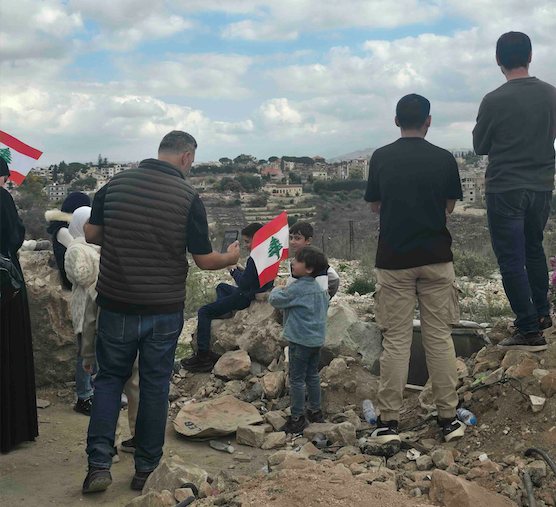
On 21 July, Israeli forces pulled back from Zawtar al-Gharbieh, allowing units of the Lebanese Army to enter. Yet the withdrawal was largely a geographical sleight of hand. Before leaving, Israeli engineering units had already flattened roads, severed water networks, and reduced homes to rubble. It left the mayor, Al-Abd Ezzeddine, to state plainly that the village had been rendered uninhabitable. Worse still, Israel unilaterally demarcated a so-called ‘Yellow Line’ cutting straight through Zawtar al-Gharbieh and skirting Froun and Srifa, north of the United Nations Blue Line established after the May 2000 liberation.
By August, Israeli troops were already staging nighttime incursions back into Zawtar al-Gharbieh in breach of the pilot zone rules. Meanwhile, just a few hundred metres away, Zawtar al-Sharqiyeh remained under direct Israeli military occupation.
Under the umbrella of this ‘Framework Agreement’, which Beirut's political class hailed as the restoration of the state's exclusive decision over war and peace, the destruction of the border and Litani-adjacent villages did not end; it became bureaucratised. Instead of mass aerial carpet-bombing that might trigger inconvenient headlines in Washington or Paris, Israeli forces shifted to methodical, house-by-house demolition using armoured bulldozers and explosive charges.
Take the testimony of Ismail, a 68-year-old resident of Zawtar al-Sharqiyeh, and his wife Saada, published by Al-Akhbar on 21 November. Their home was not a simple concrete block thrown up during a property boom; it was a traditional stone house with carved architectural detailing where the couple had lived for 45 years. Both were salaried employees who had invested their savings into the surrounding plot, planting fruit trees, establishing an apiary for honey production, and building a poultry coop to supplement their income.
A relative standing in Zawtar al-Gharbieh sent them a live video feed on his phone as Israeli bulldozers tore the stone walls apart. “Every stone that came down felt as though it were falling onto our hearts”, Saada said.
By Sunday morning, 22 November, artillery shells struck Wadi al-Salouqi and the outskirts of Baraachit, Al-Qantara, Haddata, Kfar Tebnit, al-Khiyam, and al-Mansouri, and four airstrikes hit Kfar Tebnit itself. The villagers gathered in Zawtar al-Gharbieh watched as another wave of demolitions unfolded across the divide in Zawtar al-Sharqiyeh. One can't help but notice the legal and diplomatic inversion at work here.
The Lebanese Armed Forces are deployed in Zawtar al-Gharbieh, prevented by the rules of the international monitoring mechanism from intervening across the line, and often tasked with holding back angry civilians from approaching the perimeter. The international committee, also known as ‘the Mechanism’, notifies the Lebanese Army of impending Israeli detonations, reducing a sovereign national military to the role of traffic warden while a foreign army demolishes Lebanese property.
There is a deep historical irony in President Aoun choosing the cliffs of Nahr al-Kalb for his Independence Day address. For over three millennia, every passing empire — from Pharaoh Ramesses II and Assyrian King Esarhaddon to Roman Emperor Caracalla, Napoleon III, and General Edmund Allenby — chiselled commemorative inscriptions, called stelae, into the limestone gorge north of Beirut to boast of conquering the Levant.
In 1946, Lebanon added its own plaque celebrating the evacuation of the last foreign troops. Standing beside those imperial carvings while foreign drones hum over Nabatieh and Israeli sappers wire explosives in Zawtar al-Sharqiyeh illustrates the central contradiction of the Lebanese state since its inception in November 1943.
The textbook version of Lebanese independence taught in schools is a tidy, sanitised affair. On 11 November 1943, Free French delegates under Jean Helleu arrested President Bechara El Khoury, Prime Minister Riad al-Solh, and several cabinet ministers, locking them in the citadel of Rashaya. Eleven days of strikes and British diplomatic pressure forced France to release them on 22 November, and a sovereign republic was born.
What the official curriculum routinely omits is how precarious, conditional, and geographically uneven that independence was from day one, particularly for south Lebanon. When General Henri Gouraud proclaimed Le Grand Liban from the steps of the Pine Residence in Beirut on 1 September 1920, he annexed the districts of Tyre, Sidon, Nabatieh, and Marjeyoun. They make up the heartland of Jabal Amel to Mount Lebanon, against the express wishes of the region's population.
Months earlier, in April 1920, hundreds of scholars, notables, and clan leaders from Jabal Amel had convened at the Wadi al-Hujayr conference, endorsing Faisal's Arab government in Damascus and rejecting French mandate rule.
France responded with a punitive military campaign led by Colonel Nieger, shelling villages, imposing crushing collective fines in gold, and driving leaders such as Sadiq al-Hamza and Adham Khanjar into armed insurgency. Even after 1943, the Beirut political establishment treated the south not as an integral pillar of the republic, but as a peripheral buffer zone.
While public investment poured into Beirut's banking sector and Mount Lebanon's resorts during the ‘Golden Age’ of the 1950s and 1960s, southern villages lacked paved roads, hospitals, secondary schools, and running water. Worse, the state deliberately abdicated its primary duty: territorial defence.
To grasp why the people of Zawtar al-Gharbieh and Zawtar al-Sharqiyeh refuse to leave the edge of their land despite drones and artillery, one has to trace the century-long Zionist design on the Litani River. In 1919, Chaim Weizmann presented the Zionist Organisation's territorial demands to the Paris Peace Conference. He explicitly drew the northern border of the proposed Jewish state just south of Sidon to encompass the entire lower Litani basin and the headwaters of the Jordan River.
Although the Anglo-French Paulet-Newcombe Agreement of 1923 placed the border further south, Israeli strategic doctrine never abandoned the Litani. In 1954, Moshe Sharett recorded in his personal diaries how David Ben-Gurion and Moshe Dayan proposed finding a Lebanese Christian officer to declare a kind of marionette state in the south so Israel could annex the territory up to the Litani.
That blueprint was put into practice in March 1978 with Operation Litani, and again in June 1982, when Ariel Sharon's armoured divisions rolled all the way to Beirut. During those years, the official apparatus in Beirut collapsed or collaborated. In May 1983, the Lebanese Government signed the US-brokered 17 May Agreement with Israel. It was a treaty that would have turned south Lebanon into a joint security zone under Israeli hegemony and stripped Lebanon of independent foreign policy. It was not diplomatic finesse in salons that tore up the 17 May Agreement or drove the IDF out of Beirut, Sidon, Tyre, and Nabatieh; it was sustained grassroots armed resistance emerging from the very villages now being lectured on sovereignty.