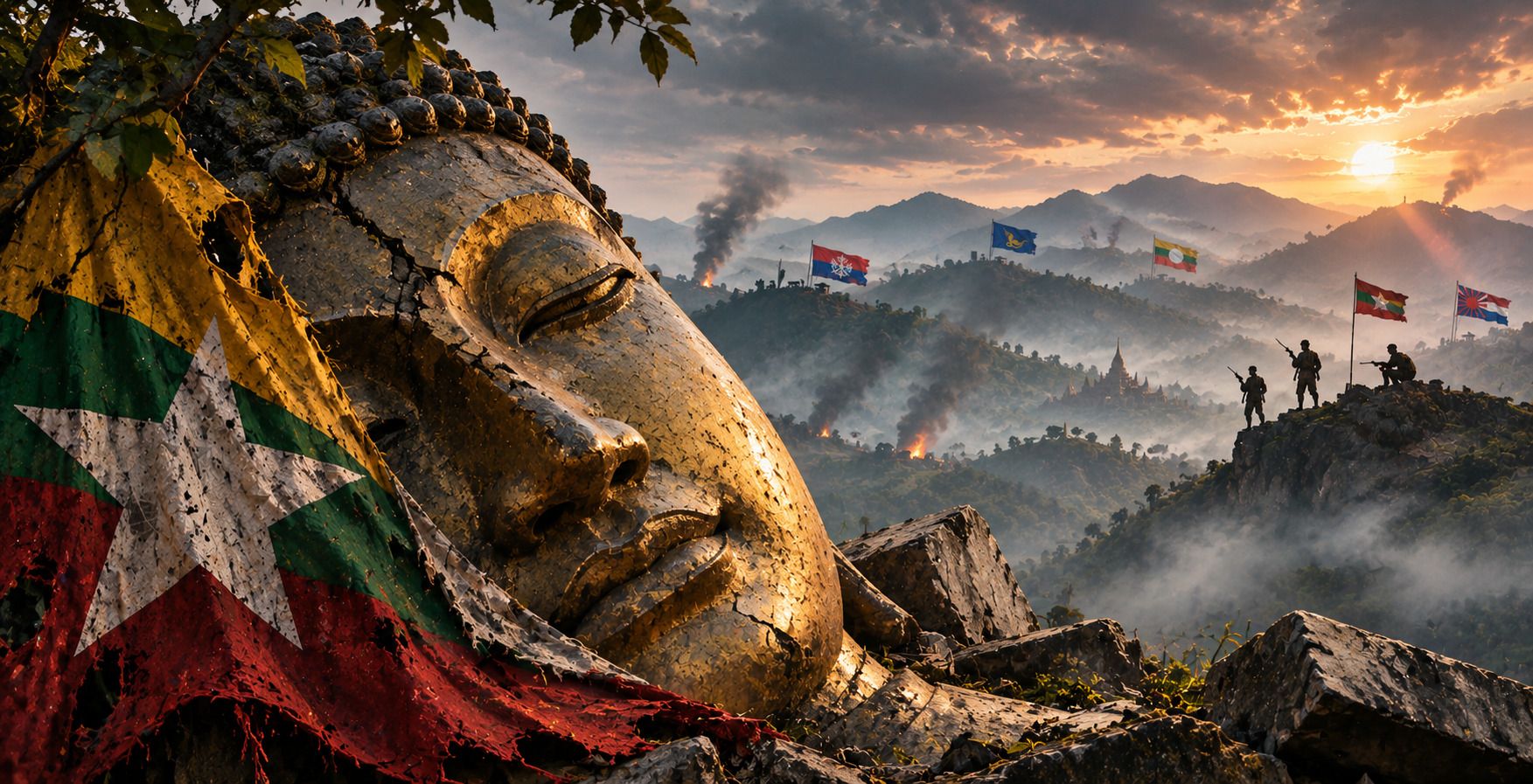
On 1 February 2021, the military seized power in Myanmar and arrested the civilian leadership of the National League for Democracy in the capital, Naypyidaw. Over the following four years, Western coverage treated the collapse of the junta as a foregone conclusion — a question of , not . The narrative was familiar: a brutal regime confined to the central plains that was losing borderland towns to heroic young urban fighters and ethnic armies.
On 8 October 2026, the UNDP's Regional Bureau for Asia and the Pacific published this from UN Assistant Secretary-General Kanni Wignaraja: “The greatest risk facing Myanmar is not only the deepening of poverty today, but the narrowing of opportunities tomorrow.”
What did the UN fear?
By late 2025, the military junta's supposedly inevitable collapse had stalled. In December 2025 and January 2026, it held a general election which was dismissed in the West as a sham. Senior General Min Aung Hlaing, architect of the 2021 coup, was elected president by a pro-military parliament, handing over formal military command to his closest confidant, Ye Win Oo.
Meanwhile, the army started to claw back territory it had lost over the previous years.
How did a military that the West had, for years, expected to collapse any minute achieve this recovery?
The answer was written in Beijing.
The Way of the Mandala
To understand why Western narratives of Myanmar keep colliding with reality, one must first dismantle a European assumption: that Myanmar was ever a cohesive nation-state in the Westphalian mould — a sovereign territory defined by hard borders, a single capital, and an uncontested monopoly on legitimate violence.
Before European colonial surveyors began drawing straight lines across jungle ridges, the expanse between the Himalayas and the Andaman Sea was organised according to what Southeast Asian historian O. W. Wolters termed the system: no hard borders, no sovereign passports, and no monolithic capital exercising absolute control.
Power was personal and radiant, defined by the reach of a monarch's spiritual aura. A king's sway was absolute at the palace gates. It rippled outwards through the river valleys and faded progressively into the highlands until it met the rival gravitational pull of a neighbouring court. It was a fluid world of tributary alliances, overlapping suzerainties, and frontier sanctuaries that blithely ignored royal decrees.
Perhaps the birthplace of the Westphalian idea of absolute nation-states could do with some reflection on the mandala in its own backyard too. Medieval and early modern Europe was a world of overlapping suzerainties: the Holy Roman Empire's patchwork of princes, bishops, and free cities owed layered and competing loyalties to emperor, pope, and local lord, and borders were zones of influence, not lines.
When the British departed Burma in 1948, they left behind ancient neighbours and competitors accustomed to the way of the Mandala, now confined behind a colonial wall.
Perhaps what the world is witnessing today is not simply a civil war, but the re-establishment of a pre-colonial equilibrium of ebb and flow, long dammed behind an imported Westphalian wall, and now fought out with resource access, drones, artillery, and jets.
The Pre-Colonial Baseline
The Ghost of Arakan
Along the western coast facing the Bay of Bengal, the kingdom of Mrauk-U was a cosmopolitan, seafaring power long before the modern state of Myanmar existed. Its court traded with the Dutch East India Company, exchanged letters with Mughal emperors, and governed independently until 1784, when King Bodawpaya's Bamar forces crossed the mountains, sacked the capital, and absorbed the realm into central Myanmar.
When the Arakan Army (AA), commanded by Major General Twan Mrat Naing, advances across Rakhine State today, is it fighting as a rebel force in a civil war, or as the restoration army of a conquered sea kingdom?
The movement is open about its goal: self-determination, or an autonomous confederation modelled on the Wa statelet.
The Muslim Rohingya also trace their claims to this pre-conquest court. Against the junta's insistence that they are recent arrivals from British-era Chittagong, groups including the Arakan Rohingya Salvation Army (ARSA) and the Rohingya Solidarity Organisation (RSO) point back to Mrauk-U, where Arabic-script coinage and a minority Muslim presence are recorded.
The Severed Tongue of Hanthawaddy
Travel south to the Irrawaddy delta and the coast, and the same historical memory persists among the Mon. In 1757, the Bamar king Alaungpaya stormed the Mon capital of Pegu, ending the Hanthawaddy Kingdom in a campaign of notable ruthlessness. Mon chronicles, as later historians recount, describe the destruction of the city, the deaths of large numbers of monks, and the suppression of the Mon language. Thousands of survivors were taken north as forced labour, while many more fled across the border to Siam (today’s Thailand).
Today's military regime, the generals in the capital Naypyidaw, still regard themselves as heirs to these conquerors, and giant bronze statues of Alaungpaya stand over military academies.
The established New Mon State Party (NMSP) maintains an uneasy truce with the regime to protect its schools and businesses, but younger generations have lost patience.
In early 2024, a breakaway faction, the NMSP-Anti-Military Dictatorship (NMSP-AMD), took up arms alongside Karen insurgents and local militias.
On the eastern plateau, the Shan (Tai) people were governed for centuries not by Burmese bureaucrats but by hereditary princes known as ‘Sawbwas’. Each valley was a city-state with its own palaces, courts, and militias. They paid tribute to the Burmese court when compelled, sent gifts to the Qing emperor in Beijing when convenient, and otherwise governed their valleys as they saw fit.
How is today's Shan politics different from yesterday's?
Along the Thai frontier sits the Restoration Council of Shan State (RCSS), defensive and watchful. To the north is its rival, the Shan State Progress Party (SSPP). Between them lie heavily armed non-Tai enclaves: the Palaung fighters of the Ta'ang National Liberation Army (TNLA), the Kokang fighters of the MNDAA, and the garrisons of the United Wa State Army (UWSA).
Beyond the river valleys, in the forested heights where the Kachin, Chin, and Karen live, lowland kings never exercised real authority.
In The Art of Not Being Governed, the Yale political scientist James C. Scott argued that these uplands were not backward frontiers but deliberate zones of state evasion. The historian Willem van Schendel named the region ‘Zomia’, and Scott made the concept famous. For centuries, highlanders chose egalitarian tribal structures, oral traditions, and rugged terrain to escape lowland taxes, forced labour and conscription.
When 19th-century British and American Baptist missionaries reached these ranges, they brought Latin scripts, printing presses, and Christianity. They gave these largely non-Buddhist peoples a distinct cultural identity that deepened their separation from the Bamar lowlands. The separation was formal as well as cultural.
In 1875, the British Empire signed a treaty with the Burmese king Mindon recognising the Western Karenni States as independent territory belonging to neither power.
When the Karen National Union (KNU), the Kachin Independence Army (KIA) or the Karenni Nationalities Defence Force (KNDF), drawing on a Karenni resistance dating back to the 1950s, fight today, are they only 21st century insurgents? Are they also people picking up the arms of their forebears to carry on with a resistance against a lowland state that has been encroaching for centuries?
The Three Lineages of the Resistance
To describe Myanmar's resistance as a single pro-democracy front is to misunderstand who carries the arms. Three distinct movements emerge from the battle lines:
1. The Pre-Colonial Heirs: ~25,000–35,000 fighters
These movements fight because their sovereignty was lost to royal conquest or broken treaties: the ULA/AA in Arakan, the NMSP in Mon country, the Shan armies defending old princely valleys, and the KIO/KIA, KNU and KNPP in the highlands. Their struggle did not start in 2021.
It began in 1757, 1885, or, at the latest, in 1948.
2. The Cold War Mutineers: ~40,000–50,000 fighters
These groups emerged from the mutinies of 1989, when ethnic hill-tribe soldiers broke with the Communist Party of Burma (CPB), which was led by ageing Bamar intellectuals. Armed with abandoned Chinese weapons, they formed the UWSA (Wa) and the MNDAA (Kokang), later joined by the TNLA (Ta'ang). Their aim is not Western-style democracy or a federal republic. It is to defend lucrative border fiefdoms tied to Beijing.
3. The Gen Z Revolution: ~65,000-100,000 fighters
These are the National Unity Government (NUG), the urban youth-led People’s Defence Forces (PDFs), and ethnic armed groups such as the KNDF in Kayah State. Equipped with 3D-printed weapons, commercial drones, and Western ideals of human rights, they seek a modern, liberal, federal democracy. They enjoy popular support, but the heavy weapons and mountain gates on which they depend are held by others.
As the junta started to lose its grip in 2021, Myanmar's neighbours quickly dealt with the situation on the ground, striking arrangements with whoever controlled the bridges, pipelines, and passes.
In the Kokang capital of Laukkai or the Wa stronghold of Panghsang, clocks run on Beijing time, an hour ahead of Naypyidaw. Shops price goods in yuan, Yunnan networks carry the mobile signal, and schoolchildren study from Chinese textbooks. The UWSA and MNDAA are armed with Chinese assault rifles, armoured vehicles, and man-portable air-defence systems (MANPADS).
In late 2023, frustrated by the junta's failure to close the cyber scam compounds in Laukkai, run by regime-aligned border militias, Beijing allowed the resistance's ‘Operation 1027’. It also let the Three Brotherhood Alliance sweep across northern Shan State, defeat the army there, and dismantle the scam hubs.
Western observers on social media and in op-ed pages reacted with excitement, boldly proclaiming that the long-predicted tipping point had finally arrived and that the end of the junta was nigh. In their enthusiasm to herald victory for the Western rules-based order, they had mistaken a Beijing-approved borderland mafia shake-up in the dense jungles of Southeast Asia for the birth of liberal democracy.
Then resistance forces overreached. In 2024, they captured the regional military headquarters at Lashio, raising the spectre of an uncontrolled collapse of Myanmar's de facto central government.
Beijing slammed on the brakes.
Chinese officials sealed the border crossings, cut cross-border electricity, severed internet access, and froze rebel bank accounts. Across the border in Yunnan, a municipal security body served the rebel Ta'ang leadership with an ultimatum: “Stop the fighting immediately … otherwise, China will take more deterrent, disciplinary, and punitive measures, and you will bear all the consequences.”
By April 2025, the MNDAA had handed Lashio back to the military. By October 2025, the TNLA had signed a Chinese-brokered truce, giving up the ruby mining hub of Mogok and nearby Momeik after the army retook Nawnghkio, Kyaukme, and Hsipaw. By March 2026, the Beijing-favoured MNDAA was turning against its former ally to seize Kutkai. By July 2026, TNLA delegates were sitting across from junta officials in Naypyidaw.
With a few decisive moves, Beijing had disrupted the Three Brotherhood Alliance.
Myanmar analyst Dr Hla Kyaw Zaw said in a 2024 interview with : “China holds all of Myanmar's economic lifelines. Therefore, the ethnic nationalities cannot survive without relying on China … they can only conduct business if China keeps the border gates open.”
China, at the UN Human Rights Council in Geneva, on 7 September 2026, lamenting that the Myanmar government was not present, said: “China … regrets that Myanmar, as the country concerned, does not participate in the dialogue. And this year, Myanmar has held its general election, and the new government has put in place new policies, making every effort to promote its domestic peace and development”.
New Delhi views the situation with strategic anxiety, wishing to protect its Kaladan Multi-Modal Transit project whilst fearing that separatist groups in Manipur and Nagaland could use Myanmar's jungles as bases. It therefore maintains relations with Naypyidaw. On the ground, it also has backchannels with the Arakan Army, which controls the Kaladan river route. Mizoram's state government, meanwhile, shelters and supports ethnic Chin kin fighting under the CDF and CNF banners.
India said at the UN in September 2026: “India remains steadfast in its support for Myanmar's sovereignty and territorial integrity and for Myanmar-led effort towards peace, stability, national reconciliation and socio-economic development.”
When Chinese support wavers and Western sanctions bite, Min Aung Hlaing turns to Moscow. Russian Sukhoi Su-30 fighters, Mi-35 attack helicopters, and aviation technicians give the junta air supremacy. In return, the regime has signed civilnuclear cooperation agreements and offered Russia access to Indian Ocean trade routes.
At the UN Human Rights Council on 7 September 2026, the Russian representative denounced Western interference:
We believe that the quest for a resolution of the crisis in this country should be based on the principles of sovereignty, non-interference in internal affairs, and equal dialogue. Thus, we condemn the practice of a number of states using multilateral fora, including this one, to render pressure on the government through unilateral coercive measures, politicizing the human rights agenda, and attempts to isolate them only worsen the situation of the people of Myanmar and hinder constructive cooperation. We are against attempts to place all the responsibility for the current situation exclusively on the authorities in Naypyidaw.
The Limits of Western Pressure
Western policy, led by Washington, London, and Brussels, remains largely declaratory.
There are sanctions on junta financial interests, embargoes on aviation fuel, non-lethal assistance under the US BRAVE Burma Act, and a steady stream of statements in Geneva.
There appear to be no significant supplies of weapons, air-defence systems or other hard strategic support.
The British representative said at the UN Human Rights Council on 7 September 2026:
Airstrikes remain the leading cause of civilian deaths, striking schools, hospitals and places of worship. The Myanmar military's use of forced conscription, arson and arbitrary detention have driven displacement beyond 3.6 million. The Mechanism's evidence of sexualised torture in military detention facilities including of children, is deeply disturbing. We are gravely concerned by violations against ethnic and religious minorities nationwide, forced labour, forced conversions, and extortion.
How is this to be understood?
Whereas other UN Security Council members are concerned with the political and societal stability of the region that divides the Indian Subcontinent from Southeast Asia, the only thing the West can do is to turn the humanitarian megaphone all the way up to where the dial reads “politics”. They can only blame the military junta, which forms the central government, for all kinds of crimes against humanity, however real those crimes may be, without having put forward a single constructive proposal for a solution involving all sides in the conflict.
Correlation of Forces
The following balance sheet estimates the ground reality in Myanmar in 2026: who commands the forces, who controls the terrain and whose foreign patrons supply the weapons, money, and diplomatic cover.