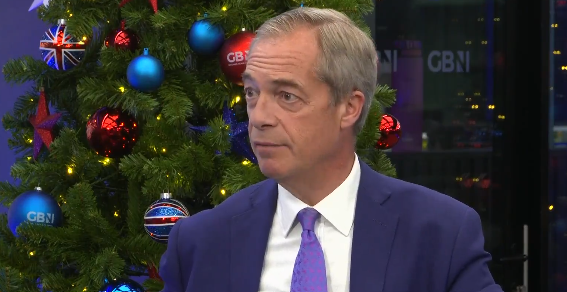
Tommy Birch is a behavioural scientist and leadership advisor at House of Birch, Director at Metamindz, a local councillor and CPF Area Leader for Hertfordshire.
When YouGov put the Conservatives ahead of Reform UK in October, I will admit I read the figures twice.
One poll inside the margin of error proves very little, but it has not stayed on its own. The latest YouGov poll, conducted on 8 and 9 November, has us at 21 per cent and Reform at 20. Labour still leads both parties on 27 per cent, so nobody should be popping champagne.
But consider where we were just a a year ago. Reform was setting the political agenda, Farage seemed to dominate every conversation, and the Conservatives were struggling to get a word in edgeways. Now, for all the attention he still commands, that dominance looks rather less secure.
So what has happened to Nigel Farage? The easy answer is a difficult summer of headlines, the Clacton by-election and growing scrutiny of Reform’s claims to be different from the political establishment. But I think the easy answer misses something more interesting.
Farage has never really needed to be liked. His career has been built on being disliked by the right people, loudly and often, and for a long time that worked brilliantly. What we may be watching now is the point at which that strategy runs out of road.
As a behavioural scientist, I find Farage fascinating because he understands something about human attention that most politicians don’t. Our minds are particularly alert to threats and unpleasant information. Baumeister and his colleagues captured the tendency in a paper with a wonderfully blunt title: ‘Bad is stronger than good’. Negative experiences can weigh more heavily than positive ones. Every furious reaction to a Farage remark brings attention, and he has long known how to exploit it.
But attention is only half the trick. When a BBC presenter or a Labour minister attacks Farage, some supporters hear more than criticism of a politician. They hear criticism of people like themselves. If you already feel looked down on, a sneer from someone you regard as part of the establishment can confirm your suspicions. The criticism intended to weaken him may instead strengthen your attachment.
There is a second layer. Where trust in institutions is low, being disliked by the establishment can become a credential. Anyone can call themselves an outsider however being visibly loathed by the supposed insiders is harder to fake. For a voter who feels ignored, the hostility itself becomes the proof.
That is why Farage on a stage is formidable. The room is charged before he says a word, and he knows exactly what to do with it.
So why might the numbers be turning? I think three things are happening, all rooted in how voters make decisions.
The first is that the shield only works against one kind of attack. When Farage is criticised for what he believes, his supporters treat it as an attack on them. But when questions arise about how he behaves, that defence becomes harder to sustain. A voter can shrug off a sneer from a newsreader; it is much harder to shrug off doubts about whether the man you backed to clean up politics is really any different from the rest. Integrity is not a culture war. For years his strategy has been to turn hostility into loyalty, but it cannot necessarily do the same with doubt.
The second is that outrage has diminishing returns. The brain adapts to repeated stimulation, so what shocks us the first time barely registers the tenth. A strategy built on provocation needs ever bigger provocations to get the same reaction, and each escalation risks costing a little more of the middle ground. But the problem goes beyond attracting new voters. Can outrage alone sustain the loyalty of those who have only recently joined his ranks? With a YouGov poll in July finding that 73 per cent of Conservative voters who had defected to Reform would consider returning, I’d say the answer is no.
The third, and I think the most important, is a change in the question voters ask themselves. For much of this Parliament, telling a pollster you would vote Reform could have been an expression of anger as much as a settled choice of government. Someone needs to shake this lot up. But the more seriously a party is discussed as a prospective government, the harder it becomes to avoid the practical questions.
There is a difference between imagining a Farage government and contemplating what it might actually mean. When a decision feels distant, we can think about it in broad terms of identity and ambition. As its consequences become more tangible, the details intrude. Would I actually hand him the keys? Would I trust him with my mortgage, my parents’ care, the country’s security? This does not mean voters suddenly become perfectly rational. It means that protest and governing credibility are not the same test.
This is where the contrast with Kemi Badenoch becomes interesting. She has never tried to be loved for being hated. Her rise has been slower and less theatrical: performances at the despatch box, a response to the Budget and a conference that sought to show a party with a plan rather than simply a grievance. The latest YouGov head-to-head is striking. Asked who would make the better prime minister, 43 per cent chose Kemi against just 15 per cent for Farage, his lowest figure in that series. In summer 2025, the two were level.
Those numbers do not prove that the public trusts the Conservatives again. Far from it. But they suggest Kemi has an opportunity Farage may struggle to match. He has spent years cultivating intensity. Her task is to turn a growing willingness to consider the Conservatives into confidence that we can govern. There is an enormous difference between preferring her to Farage and handing our party power.
None of this means the job is done. A lead of a point in the low twenties is a beginning, not a recovery, and Labour remains ahead. Voters considering a return to us are doing so on probation. We keep them by being competent where Reform appears chaotic, consistent where others improvise, and focused on their lives rather than our opponents.
Farage has shown that being hated can make you famous. He has not shown that it can make you trusted. Attention can be won in a week; trust takes years. And it is trust, not volume, that wins general elections.