Net migration in the year ending June 2026 fell to just 77,000, the Office for National Statistics says.
In its report just out, it says:
Our provisional estimates show long-term international net migration stood at 77,000 in year ending (YE) June 2026 and has more than halved compared with YE June 2025 (updated to 204,000). Excluding the coronavirus (Covid-19) pandemic, when international travel restrictions were in place, this is the lowest recorded net migration estimate since 1997 (when we used surveys to measure migration rather than administrative data).
Before the 2010 general election, David Cameron said he wanted to get net migration below 100,000, and successive Tory leaders also repeated that target. Sixteen years later, after a period when annual net migration rose close to one million, the Cameron target has finally been achieved.
The , a migration thinktank based at the University of Oxford, has released this statement about the reasons for the fall in net migration recorded in today's figures. It says
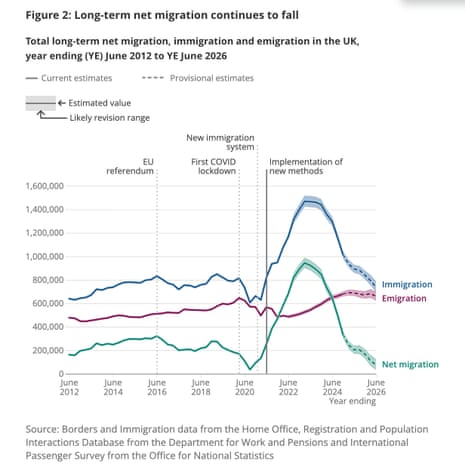
The fall brings UK net migration below the "tens of thousands" level that was a key unfulfilled government target throughout the 2010s. The 62% fall over the past 12 months-from 204,000 on the year ending June 2025-results from lower immigration. Net migration has fallen over 90% since the peak of 944,000 in the year ending March 2023.
The data now cover two full years of data since the election, and close to a full year since Labour restricted work migration in July 2025. Immigration fell by 17% over the year, driven by fewer non-EU citizens in all major categories: work (down 25%), study (down 11%), family unification (down 30%), and asylum (down 22%). This follows 2025 restrictions making care workers and several mid-skilled jobs ineligible for work visas and suspending family reunion for refugees. The government has also raised compliance requirements for universities sponsoring international students.
Emigration also remained relatively high but fell by 4% (-28,000) compared to the year ending June 2025. High emigration contributes to the overall low net migration figure, but does not result directly from current government policy – most emigrants were non-citizens who previously migrated for work or study, including under the post-Brexit immigration system when immigration was unusually high. EU citizens, primarily people who arrived under free movement, also contributed to the emigration figures, with a negative net migration figure of 45,000.
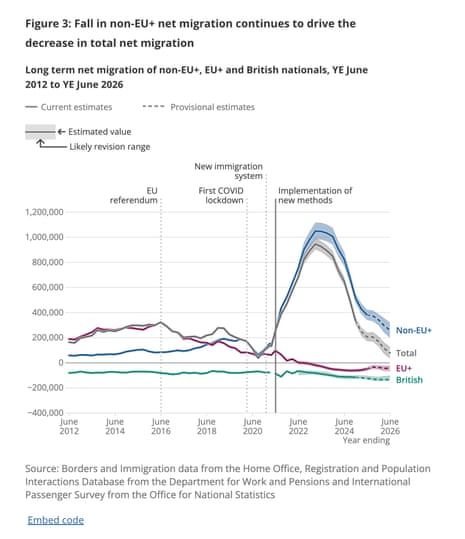
Here are the figures from the ONS showing net migration figures by category – British nationals, EU+ (EU nationals, plus Norway, Iceland, Liechtenstein and Switzerland), and non-EU+ nationals.
The Government is expected to publish more documents on the appointment of Peter Mandelson as US ambassador shortly, with the security minister set to address MPs at about 12.30pm, the Press Association reports. PA says:
will give a statement in the Commons on the latest release of papers which cover the vetting process into Mandelson before he was sent to Washington.
The disgraced peer was sacked from his position last year after more details emerged about his close links to paedophile financier Jeffrey Epstein.
The scandal played a significant role in the eventual resignation of Keir Starmer, with questions raised about how much the then-prime minister knew when he made the appointment.
More than 1,500 pages of documents were published earlier this year, including messages between Mandelson and cabinet ministers.
However, some were withheld at the request of the Metropolitan police as part of their investigation into the former Labour minister and spin doctor.
Mandelson was arrested in February on suspicion of misconduct in public office. No charges have been made. He has denied any allegations and is co-operating with police.
The Met has since informed the government the documents can be published without affecting their investigation.
In February, MPs voted for the papers to be released using a parliamentary mechanism known as a "humble address" and agreed that unredacted files would be first viewed by parliament's intelligence and security committee (ISC) before being published.
The latest tranche of documents have been seen by the ISC and are now expected to be put before MPs.
Previous documents have shed light on messages between Mandelson and Labour cabinet ministers.
Former chief secretary to the prime minister, Darren Jones, had contacted the peer to tell him he had done a "great job" on the day of his sacking.
Meanwhile, work and pensions secretary Pat McFadden had complained to Lord Mandelson that Labour backbenchers were asking "who can we tax in order to pay benefits to others".
Mandelson himself was seen to describe No 10 as "beleaguered and bereft".
Jakub Krupa writes the Guardian's Europe live blog.
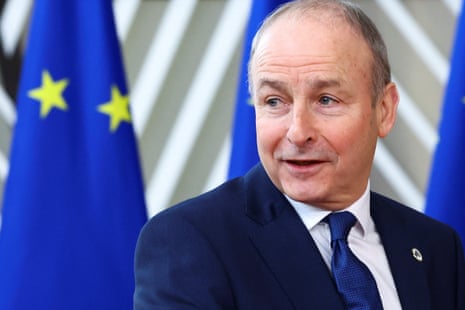
Irish prime minister said he was confident the EU and the EU "will be in a position to resolve the outstanding issue" of tuition fees, as he hailed the deals on sanitary and phytosanitary rules, youth mobility, and energy.
Speaking at the beginning of the European Council meeting in Brussels, Martin said that "for the young people of Britain and the young people of Europe, this is a win-win."
He said:
I often felt with Brexit that the young people of Britain perhaps were not consulted as strongly in terms of the implications for youth mobility.
Young people love to travel, and we don't need to be placing barriers in the way of young people accessing education, accessing work. In Europe, that should never be the case and I believe we can facilitate that.
On SPS, he said the deal was "very good news for Ireland and the UK" as it will "remove barriers" affecting small to medium size companies in particular.
The deal on the emissions trading scheme also "makes sense" as having the UK and the EU both "in the European energy market also offers up opportunities for both sides".
Martin was perhaps the only leader offering any sort of detailed answer on the EU-UK relations when asked about the hold-up caused by the lack of agreement on tuition fees, with most of them just delivering general platitudes about the EU-UK relationship post Brexit.
Czech Republic's chuckled and said he thought it was a mistake for Britain to leave, but welcomed its involvement in peace talks on Ukraine, while Latvia's said he wasn't across the detail on that issue.
Sweden's also said he was "not into details" on that point, but welcomed "a major step forward" in relations with Britain.
There is full coverage of the summit here.
, the Reform UK leader, has spent much of his career complaining about there being too much immigration. In response to today's figures showing it has again fallen (see 9.38am), he is now complaining about – too much emigration by UK nationals! In a post on social media, he says:
Net emigration of British people over the last 10 years is nearly 1 million (941,000), we've lost a whole generation of young Brits and replaced them with small boat migrants.
Farage is wrong about the numbers. While a large number of people have arrived in the UK on small boats in recent years (217,000 since 2018, when the Home Office started compiling the figures), that is nowhere close to matching the net emigration figure he quotes.
His only social media comment on immigration (so far today) is to say that Reform UK would abolish the graduate visa system. He says:
It's too hard for young people to get a job in Britain.
So Reform will ABOLISH the graduate visa.
It lets foreign students stay after their degree for two years, compete for entry-level jobs OR claim asylum!
The Tories created it. Labour kept it.
I'll end it.
The Liberal Democrats are saying the UK needs a proper plan for immigration. This is from the party's asylum and immigration spokesperson, .
Britain needs to regain control of its immigration system after the chaos of Brexit. Yet sixteen years after David Cameron's 'tens of thousands' pledge, six prime ministers and ten home secretaries have overseen wild swings in immigration numbers with net migration now set to fall below zero.
The Conservatives say net migration is still too high. , the shadow home secretary, has issued this statement about today's figures.
The fall in net migration is mainly a result of changes made by the previous Conservative government. We now need to go even further with a legally binding annual cap, set by parliament, at a far lower level.
British and European people are leaving in their droves because of Labour's high taxes whilst non-EU immigration remains far too high. British families are left to pay for it with lower wages, longer waits for a GP appointment and homes they cannot afford. Mass low-skilled immigration must end completely as it is bad for our economy and corrosive to our society.
Labour's shameful U-turn on indefinite leave to remain throws open the door to early permanent settlement, benefits, and citizenship for low-skill migrants. Conservatives will take settlement away from those not making a contribution and they will be made to leave – no matter what Labour has promised them.
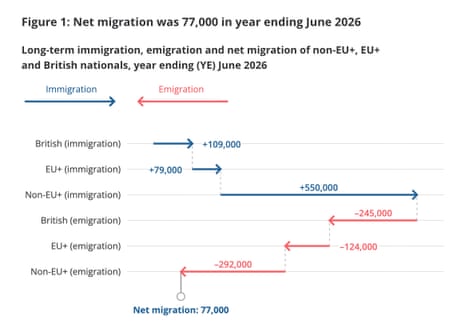
More British nationals are estimated to have left the UK in the year to June 2026 (245,000) than moved to the country (109,000), the Press Association reports. PA says:
It was a similar picture for nationals from "EU-plus countries" – covering the 27 members of the EU plus Norway, Iceland, Liechtenstein and Switzerland – with a higher number emigrating from the UK (124,000) than immigrating (79,000), according to the ONS.
By contrast, more people from outside the EU moved to the UK in the year to June (550,000) than left (292,000).
The number of British nationals leaving the UK is estimated to have fallen slightly in recent years, with 245,000 in the year to June 2026, 251,000 in the year to June 2025 and 257,000 in the year to June 2024.
This is from Sunder Katwala, director of , a thinktank focusing on race and immigration issues, on today's net migration figures.
Figures showing net migration falling to its lowest level since 1997 will come as a surprise to most of the public, who thought immigration was still rising. It must now be time for the political and media debate to catch up and start a new phase of the debate about what happens next.
With numbers expected to keep falling, the government needs to ask what a sustainable level of immigration is, and how will they achieve it.
Whatever their views on the right level of immigration, any party that is serious about the issue should be able to commit to an annual 'immigration budget' process setting out trends, expectations and choices.
Andy Burnham's Labour government could aim for a net migration ceiling of 250,000. But at the level announced today, the UK population is now shrinking – so a medium-term aim should be to stabilise net migration with a floor of 100,000 to avoid population decline. Reform and the Conservatives, who want net emigration, should set out what they would cut and how to manage the impacts.
Katwala is right about the public not realising that immigration is falling. Polling published just yesterday shows that many voters wrongly believe immigration is still rising, and that Reform UK supporters are most likely to think this.
And this is how the ONS explains the fall in net migration in its report. Mainly it is because of a steep fall in the number of non-EU nationals coming to the UK, it says. This is a consequence of visa rules becoming much stricter. The last Conservative government first tightened the rules very significantly, and this crackdown has largely continued under Labour.
Another factor is more Britons, and EU nationals, leaving the UK than entering or returning.
The ONS says:
While people arriving from outside the EU continued to add to the population, non-EU+ provisional net migration fell to 258,000 in YE [year ending] June 2026, down from 379,000 a year earlier.
The fall in the net migration of non-EU+ nationals was the main reason for the latest decrease in overall net migration. It was driven by non-EU+ immigration falling by more than 100,000, while emigration remained broadly stable. Compared with YE June 2025, non-EU+ arrivals for work-related reasons fell by 45,000, asylum-related reasons fell by 19,000 and study-related reasons fell by 33,000.
Unlike non-EU+ nationals, more British and EU+ nationals left the UK long term than arrived. Provisional net migration for British nationals remained broadly stable at negative 137,000, while EU+ net migration was negative 45,000 and has been negative since YE June 2022.
And this chart from the ONS report shows how immigration, emigration and net migration figures have changed since 2012.
This chart from the ONS report explains how the net migration figure ends up at 77,000.
Net migration in the year ending June 2026 fell to just 77,000, the Office for National Statistics says.
In its report just out, it says:
Our provisional estimates show long-term international net migration stood at 77,000 in year ending (YE) June 2026 and has more than halved compared with YE June 2025 (updated to 204,000). Excluding the coronavirus (Covid-19) pandemic, when international travel restrictions were in place, this is the lowest recorded net migration estimate since 1997 (when we used surveys to measure migration rather than administrative data).
Before the 2010 general election, David Cameron said he wanted to get net migration below 100,000, and successive Tory leaders also repeated that target. Sixteen years later, after a period when annual net migration rose close to one million, the Cameron target has finally been achieved.
We should get the latest Mandelson documents (see 9.17am) around lunchtime. The Commons authorities have announced there will be two ministerial statements today. At around 11.30pm Polly Billington, an energy minister, will make a statement about the latest price cap announced by Ofgem yesterday. And, about an hour later, Dan Jarvis, the security minister, will make a statement described as an "update on the government response to the Peter Mandelson humble address motion".
from Sky News has posted this on social media about what the new documents might reveal.
In today's Mandelson files, I'm expecting a revealing look into the desperate attempts by the civil service to manage the political curveball they'd been thrown by Keir Starmer and Morgan McSweeny.
Mandelson was a political appointment, pretty much forced through by No 10 with nobody listening to the warnings. Keir Starmer's team were not interested in the problems with this appointment.
So I believe you'll see:
civil service emails about how to manage the conflict of interest with his shares in Global Counsel.
Emails to Peter Mandelson as official tried - as was their job - to help him at the height of the crisis.
And potentially how Mandelson was helping official figures directly with Global Counsel outside of the watchful eye of the diplomatic service.
Mandelson denies wrongdoing
Good morning. On Friday last week Andy Burnham was in Brussels to announce a reset deal with the EU. Today the debate will be revived as we get to read the small print.
We are getting three documents that should help experts assess the merits, or otherwise, of the deal. They are: the text of the legislation implementing the deal, formally known as the European partnership bill, but which ministers are calling the cutting costs bill; the legal text of the deal on food standards, which runs about 200 pages; and the legal text of the deal on emissions trading.
, the BBC's economics editor, has more here on what the legal text will show. He says it will confirm that the food deal has "a 10-year termination clause that would mean if one party ended the agreement, they would have to pay to rebuild border checks infrastructure, which will be significantly scaled back as part of the new deal". Termination clauses like this are not unusual in trade deals, but this one has been dubbed the "Farage clause" because it is partly inspired by the EU's worry about Reform UK winning the next election and ripping up the deal. It could be called the Badenoch clause too, because the Tories also want to scrap the deal, but Farage is better known in Brussels, where he is considered a more formidable enemy than the Tory leader.
The government says its European partnership bill will "save industry millions by cutting red tape, lifting bans on iconic British exports, and exempting £6.5bn of British exports from EU carbon taxes".
But the are claiming any savings for customers are minimal. Here is an extract from the news release issued overnight.
Analysis by the Conservatives of the government's own estimates shows that the savings from the sanitary and phytosanitary (SPS) deal will amount to just pennies on everyday essentials, despite Andy Burnham promising the deal would bring down food prices.
Beef prices have risen by 27.8 per cent since Labour took office, adding £1.22 to a pack of beef mince. Yet the government's SPS deal would save shoppers just over 1p on a £5.60 pack.
Pork prices have increased by 9.6 per cent, adding 29p to a pack of pork loin steaks, while the deal would cut the price by barely 1p. A six-pack of tomatoes would become just half a penny cheaper, while a head of broccoli would fall by less than a third of a penny.
Currently half of all the pickled gherkins Britain imports come from the EU, yet on the government's figures its EU deal will take just over half a penny off a £1.40 jar of gherkins. However, this would be on top of the government's generous 4p cut announced at the budget.
If you don't fancy reading 200 pages of legal text, there might be some more juicy documents coming from the government today when it publishes a fresh tranche of documents required by the humble address on Peter Mandelson. These are the papers relating to his appointment as ambassador to the US. Most documents have already been released but some – particularly those relating to what Mandelson told No 10 when it asked specifically about his links to Jeffrey Epstein – were held back at the request of the police (who are still pondering whether to charge him with misconduct in public office in relation to leaks to Epstein). Now the government is able to release a further tranche. They will come at some point today, but we are not sure when.
Here is the agenda for the day.
9.25am: Karin Smyth, the health minister, speaks at the NHS Alliance conference. Sir Jim Mackey, the outgoing NHS England chief executive, is also speaking, at 1.30pm.
9.30am: The Office for National Statistics publishes the latest net immigration figures. At the same time, the Home Office is publishing its latest quarterly asylum figures.
9.30am: The Ministry of Housing, Communities and Local Government publishes its latest homelessness figures.
9.30am: The ONS publishes figures for young people not in education, employment or training (Neet).
Kemi Badenoch is on a visit in Sidcup.
Wes Streeting, the defence secretary, is on a visit in Plymouth.
11.30am: Downing Street holds a lobby briefing.
Around lunchtime: The government is due to publish its European partnership bill, the legislation enacting the three deals with the EU announced last week. The government is also publishing the legal text of two of those deals, the food standards (SPS, or sanitary and phytosanitary) one, and the emissions trading one.
2pm: Friends, relatives and colleagues will attend a memorial service for Ann Widdecombe at Westminster Cathedral.
And at some point today the government is due to release those Mandelson papers.
I'm afraid we are no longer able to have comments open below the line every day on this blog. If you want to contact me, please email politics.live@theguardian.com. You can use this email to flag up corrections, comments for publication, questions or complaints.